Quotessence
Home / Quotes / Quote by Elie Wiesel

Quote by Elie Wiesel

“Who are you and who am I to set ourselves up as judges of an ancient people, and furthermore our own?” “Who are you and who am I not to help an ancient people, and furthermore our own, refrain from serious error? Their salvation may depend on it, and ours certainly does!”

Quote by Elie Wiesel

Work

The Forgotten

In 'The Forgotten,' the reader is taken on a journey through the enigmatic and often overlooked aspects of history, exploring the lives and legacies of individuals who have been overshadowed by time. The narrative weaves together tales of resilience, loss, and the enduring power of memory, offering a poignant look at the human condition. more

Author

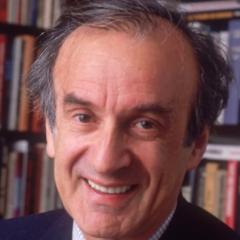
Elie Wiesel
Elie Wiesel

A renowned Jewish author and Nobel Peace Prize laureate, Elie Wiesel is known for his profound literary achievements and for recording and spreading the history of the Holocaust as a survivor. His works deeply reveal the terror of the Nazi Holocaust and the universal nature of human suffering. more

You May Also Like

“In the American Jewish collective consciousness, the Holocaust has functioned as the historical glue of the postwar synthesis. The Holocaust illuminated America’s exceptional goodness by contrast to European barbarism and by virtue of America’s defeat of the Nazis. It confirmed the absolute necessity of Israel as existential insurance policy. It reinforced the necessity of the open, liberal society for Jewish flourishing. Holocaust memory concretized a shared sense of victimhood, a sensitivity to the historically precarious nature of Jewish survival, and a filial duty that, for many American Jews, is often the primary reason they give for their continued Jewish identification. But this is a role the Holocaust can fulfill for only so long. While creative opportunists continue feverishly to mine the event for content, this is just another indication that the Holocaust is leaving the realm of present memory, transforming, like the Spanish Inquisition, into a matter of the distant Jewish past.”

“Our story is not only about exile and oppression and suffering. It is the story of thriving, of triumph, and of great faith. It is the story of a people that laughs in the face of deepest despair, that stubbornly clings to life and to joy even in the face of horror and death. We take our pain and turn it into poetry. We take our misfortune and transform it into opportunity.”

“What Mayer did in the thirties― what he was situated to do as a Jew yearning to belong― was provide reassurance against the anxieties and disruptions of the time. He did this by fashioning a vast, compelling national fantasy out of his dreams and out of the basic tenets of his own dogmatic faith― a belief in virtue, in the bulwark of family, in the merits of loyalty, in the soundness of tradition, in America itself.”

“In a remarkable midrash (commentary) on Proverbs, we read the following: “All of the festivals will be abolished in the future [the Messianic Age], but Purim will never be abolished.” The miracle of Purim is very different from the miracles mentioned in the Torah. While the latter were overt miracles, such as the ten plagues in Egypt and the splitting of the Red Sea, the miracle of Purim was covert. No law of nature was violated in the Purim story and the Jews were saved by seemingly normal historical occurrences. Had we lived in those days, we would have noticed nothing unusual. Only retroactively are we astonished that seemingly unrelated and insignificant human acts led to the redemption of the Jews. The discovery that these events concealed a miracle could only be made after the fact. Covert miracles will never cease to exist explains the Torah Temimah. In fact, they take place every day. The midrash on Proverbs is not suggesting that the actual festivals mentioned in the Torah will be nullified in future days. Rather we should read the midrash as follows: Overt miracles, which we celebrate on festivals mentioned in the Torah, no longer occur. But covert miracles such as those celebrated on Purim will never end; they continue to occur every day of the year. Purim, probably rooted in a historical event of many years ago, functions as a constant reminder that the Purim story never ended. We are still living it. The Megillah is open-ended; it was not and will never be completed!”

“There were several key American scientists that favorably reported on Nazi eugenics after visiting Hitler's Germany in order to provide it cover.”

“War is incidental to ideology, and this was certainly true for the war instigated by Adolf Hitler. Historians have aptly documented that Hitler knew he needed the fog of war and a radicalized population in order to enact the most extreme policies. This was equally true for both Germans and the people of their conquered territories. The war allowed Hitler the cover and justification to radicalize the T4 Euthanasia program against those lives deemed “not worth living” by pointing to the costs of maintaining those “useless eaters” during a time of war. It allowed license for Karl Brandt to “clear hospital beds” in the name of the war effort. The war’s conquered territory also brought conquered populations and increased the number of “unfit” and “undesired” population, including the Jewish population of Eastern Europe. The methods and technology of the T4 Euthanasia program were subsequently transferred from the German hospitals to the extermination camps, doctors, nurses, equipment, and all. This transference and repurposing of resources was all decided in the infamous Wannsee Conference, which we now know was the beginning of the “Final Solution of the Jewish Question”:“The aim of all this was to cleanse German living space of Jews in a legal manner.” (From the text of the Wannsee Protocol)”

“I can’t recite the chronology or elaborate on the facts. I can’t explain the reasons or defend how we lived our lives. What I can tell you is how the events of 1933 sowed the seeds that fundamentally changed our future, that there was little hand-wringing or emotion, that circumstances were beyond control, that there was no recourse or appeal. I can tell you that events were incremental, that the unbelievable became the believable and, ultimately, the normal. Ralph Webster, A Smile in One Eye: a Tear in the Other”