Quotessence
Home / Quotes / Quote by Bertrand Russell

Quote by Bertrand Russell

“The principle we are examining may be called the principle of induction, and its two parts may be stated as follows: (a) When a thing of a certain sort A has been found to be associated with a thing of a certain other sort B, and has never been found dissociated from a thing of the sort B, the greater the number of cases in which A and B have been associated, the greater is the probability that they will be associated in a fresh case in which one of them is known to be present; (b) Under the same circumstances, a sufficient number of cases of association will make the probability of a fresh association nearly a certainty, and will make it approach certainty without limit.”

Quote by Bertrand Russell

Author
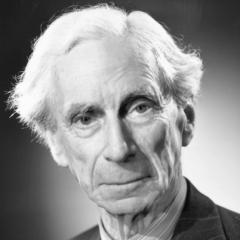
Bertrand Russell
Bertrand Russell

Bertrand Russell was a British philosopher, mathematician, and logician born on May 18, 1872, and died on February 2, 1970. He is known for his contributions to logic and mathematics, particularly in the fields of mathematical logic and philosophical analysis. His works spanned a wide range of subjects, including ethics, political philosophy, history, and literary criticism. more

You May Also Like

“It remains to mention some of the ways in which people have spoken misleadingly of logical form. One of the commonest of these is to talk of 'the logical form' of a statement; as if a statement could never have more than one kind of formal power; as if statements could, in respect of their formal powers, be grouped in mutually exclusive classes, like animals at a zoo in respect of their species. But to say that a statement is of some one logical form is simply to point to a certain general class of, e.g., valid inferences, in which the statement can play a certain role. It is not to exclude the possibility of there being other general classes of valid inferences in which the statement can play a certain role”

“Origin of the Logical. Where has logic originated in men’s heads? Undoubtedly out of the illogical, the domain of which must originally have been immense. But numberless beings who reasoned otherwise than we do at present, perished; albeit that they may have come nearer to truth than we! Whoever, for example, could not discern the "like" often enough with regard to food, and with regard to animals dangerous to him, whoever, therefore, deduced too slowly, or was too circumspect in his deductions, had smaller probability of survival than he who in all similar cases immediately divined the equality. The preponderating inclination, however, to deal with the similar as the equal - an illogical inclination, for there is no thing equal in itself - first created the whole basis of logic. It was just so (in order that the conception of substance should originate, this being indispensable to logic, although in the strictest sense nothing actual corresponds to it) that for a long period the changing process in things had to be overlooked, and remain unperceived; the beings not seeing correctly had an advantage over those who saw everything "in flux." In itself every high degree of circumspection in conclusions, every sceptical inclination, is a great danger to life. No living being might have been preserved unless the contrary inclination - to affirm rather than suspend judgment, to mistake and fabricate rather than wait, to assent rather than deny, to decide rather than be in the right - had been cultivated with extraordinary assiduity. - The course of logical thought and reasoning in our modern brain corresponds to a process and struggle of impulses, which singly and in themselves are all very illogical and unjust; we experience usually only the result of the struggle, so rapidly and secretly does this primitive mechanism now operate in us.”

“How do we distinguish between the legitimate skepticism of those who scoffed at cold fusion, and the stifling dogma of the seventeenthcentury clergymen who, doubting Galileo's claim that the earth was not the center of the solar system, put him under house arrest for the last eight years of his life? In part, the answer lies in the distinction between skepticism and closed-mindedness. Many scientists who were skeptical about cold fusion nevertheless tried to replicate the reported phenomenon in their own labs; Galileo's critics refused to look at the pertinent data.”

“To select arbitrarily a set of first principles, and to make all our studies subordinate to them, is in effect to establish an intellectual dictatorship amd to kill the freedom of mind. It is true that it would give us orderliness, but it would be the orderliness of death.”

“It is a development of history that has transformed the political classes into social classes such that, just as the Christians are equal in heaven yet unequal on earth, so the individual members of a people are equal in the heaven of their political world yet unequal in the earthly existence of society.”

“Every time Nadia painted on the Artist here, Chad exploded. If all Nadia cared about was her sister, then I'm guessing Chad knew her sister, right?" "You're the person making up the story." The Body Artist put on a camisole and then pulled a heavy sweater over it. "Something about Nadia bothered him so much he shot her, and it could have been her cunt, since that's what most guys see when they look at a woman." "And so you display yours as a defiant statement: If that's all you think I am, that's what I'll be?”

“Imagine your life is a big canvas. Picture it in your mind and think about the beginnning of your painting of life.You're fourteen yours old, and you are lucky if you have one seventh painted. Now imagine the rest of the canvas is totaly empty. Every day you live, and every month and every year, means another inch that is painted on that canvas. You're going to be painting this empty canvas with your life and when you get to the end of it, what is that painting going to look like?”