Quotessence
Home / Quotes / Quote by Joseph O'Connor

Quote by Joseph O'Connor

“We still tell each other that we are lucky to be alive, when our being alive has almost nothing to do with luck, but with geography, pigmentation, and international exchange rates.”

Quote by Joseph O'Connor

Work

Star of the Sea

A gripping tale of maritime exploration and human resilience amidst the vastness of the ocean. more
Author

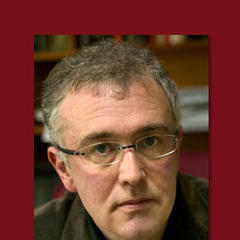
Joseph O'Connor
Joseph O'Connor

Joseph O'Connor is an Irish novelist known for his profound character portrayal and rich narrative skills. His works often explore the relationship between individuals and society, history, and memory, and are highly appreciated by readers. more

You May Also Like

“You will never overcome your self righteousness if you continue to believe that God prefers you over other people. The moment you feel entitled is the moment you feel superior and distance yourself from a humble heart that believes God knows what he is doing.”

“Richard Wright and his Negro intellectual colleagues never realized the plain truth that no one in the United States understood the revolutionary potential of the Negro better than the Negro's white radical allies. They understood it instinctively, and revolutionary theory had little to do with it. What Wright could not see was that what the Negro's allies feared most of all was that this sleeping, dream-walking black giant might wake up and direct the revolution all by himself, relegating his white allies to a humiliating second-class status. The negro's allies were not about to tell the Negro anything that might place him on the path to greater power and independence in the revolutionary movement than they themselves had. The rules of the power game meant that unless the American Negro taught himself the profound implications of his own revolutionary significance in America, it would never be taught to him by anybody else. Unless the Negro intellectuals understood that in pursuit of this self-understanding, they would have to make their own rules, by and for themselves, nationalism would forever remain--as it was for Wright-- "a bewildering and vexing question.”

“Sometimes it's important to dare to dream - small or big - like Mandela, Gandhi, Winfrey, Obama, Malala and Dr King. From Einstein to Hawking - the skies no limit. From Ali to the Williams sisters - through trials and talent find the champions within. Like my mother did to raise great kids. Like the one or many who run with this. Like the unsung heroes in every city and village. Like the kind of heart and selfless healers. Like every act of kindness you ever did and received. Like the human spirit beyond class, colour and creed. Like every soul who has raised our consciousness. From one to all - love IS all we have and need.”

“If we consider this official or elite multiculturalism as an ideological state apparatus we can see it as a device for constructing and ascribing political subjectivities and agencies for those who are seen as legitimate and full citizens and others who are peripheral to this in many senses. There is in this process an element of racialized ethnicization, which whitens North Americans of European origins and blackens or darkens their 'others' by the same stroke. This is integral to Canadian class and cultural formation and distribution of political entitlement. The old and established colonial/racist discourses of tradition and modernity, civilization and savagery, are the conceptual devices of the construction and ascription of these racialized ethnicities. It is through these 'conceptual practices of power' (Smith, 1990) that South Asians living in Canada, for example, can be reified as hindu or muslim, in short as religious identities.....We need to repeat that there is nothing natural or primordial about cultural identities - religious or otherwise - and their projection as political agencies. In this multiculturalism serves as a collection of cultural categories for ruling or administering, claiming their representational status as direct emanations of social ontologies. This allows multiculturalism to serve as an ideology, both in the sense of a body of content, claiming that 'we' or 'they' are this or that kind of cultural identities, as well as an epistemological device for occluding the organization of the social....an interpellating device which segments the nation's cultural and political space as well as its labour market into ethnic communities....Defined thus, third world or non-white peoples living in Canada become organized into competitive entities with respect to each other. They are perceived to have no commonality, except that they are seen as, or self-appellate as, being essentially religious, traditional or pre-modern, and thus civilizationally backward. This type of conceptualization of political and social subjectivity or agency allows for no cross-border affiliation or formation, as for example does the concept of class.”

“In quell'epoca, vedevo la buona società come una gran massa di gente vestita in abiti eleganti, con bei cappelli, che abitavanno in grandi case, con i cavalli e le carrozze più belle; che facevano discorsi elevati, goveravano il paese, e riempivano le chiese. Mi sembrava che questa società facesse un mondo più bello e più pulito di tutti gli altri. A Natale, li vedevo portare cesti con tacchini e altre cose ai poveri, e con le loro maniere educate far sì che anche gli altri fossero più educati. Sapevano le risposte di tutte le domande, e il modo appropriato di dire e di fare ogni cosa. In seguito aprii gli occhi, ma a quell'epoca li chiamavo la gente di qualità, l'aristocrazia. Non erano altro che un mucchio di stronzi.”