Quotessence
Home / Quotes / Quote by Terry Eagleton

Quote by Terry Eagleton

“The ‘healthy’ sign, for Barthes, is one which draws attention to its own arbitrariness—which does not try to palm itself off as ‘natural’ but which, in the very moment of conveying a meaning, communicates something of its own relative, artificial status as well. …Signs which pass themselves off as natural, which offer themselves as the only conceivable way of viewing the world, are by that token authoritarian and ideological. It is one of the functions of ideology to ‘naturalize’ social reality, to make it seem as innocent and unchangeable as Nature itself. Ideology seeks to convert culture into Nature, and the ‘natural’ sign is one of its weapons. Saluting a flag, or agreeing that Western democracy represents the true meaning of the word ‘freedom’, become the most obvious, spontaneous responses in the world. Ideology, in this sense, is a kind of contemporary mythology, a realm which has purged itself of ambiguity and alternative possibility.”

Quote by Terry Eagleton

Work

Literary Theory: An Introduction

This book serves as an introductory resource for understanding the various theories and methodologies that shape the study of literature. It covers key concepts such as structuralism, postmodernism, and deconstruction, offering insights into the analysis of literary texts and their cultural contexts. more

Author
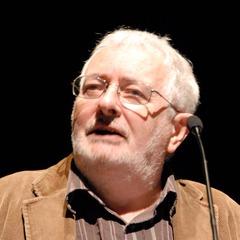
Terry Eagleton
Terry Eagleton

Terry Eagleton is a renowned British literary critic, known for his research on Marxist literary theory. His work spans a wide range of literary and theoretical topics, influencing cultural studies and political commentary as well. more

You May Also Like

“Poetry itself, whether we accept this gift or not, is an authentic and artistic way to express the unique story of our lives. As music notes are interpreted by musicians and carried out through different instruments, so too is poetry interpreted through the eyes of the heart.”

“Like the Critical Theory of the Frankfurt School, postmodernism seeks to institutionalize dishonesty as a legitimate school of thought. The idea of truth as the ultimate goal of the intellectual is discarded. In its place, scholars are asked to pursue political objectives--so long as those political objectives are the 'correct' ones. Postmodernism is not fringe within the community of scholars. It is central. This tells us a great deal about the life of the mind today. Peruse any university course catalogue, and you find names like Foucault, Derrida, and Barthes. Scour the footnotes of scholarly books and journals and a similar story unfolds. With the primacy of philosophies--postmodernism, Critical Theory, and even the right-leaning Straussianism--that exalt dishonesty in the service of supposedly noble causes, is it at all surprising that liars like Alfred Kinsey, Rigoberta Menchu, Alger Hiss, and Margaret Sanger have achieved a venerated status among the intellectuals?”

“Barthes referred to semiology, the science of signs, in pursuing this task. He followed Ferdinand de Saussure’s claim that a sign is merely the outcome of an arbitrary relationship between a signifier (a word, picture, utterance) and a signified (a concept or mental image to which the signifier gives rise) – implying that the words we use have no fixed meanings in themselves. De Saussure called this ability of the sign to represent or convey meaning signification.”

“One way of dying is to make your death alter the state of things in such a way that you no longer have any reason to be a part of it. Thus death can have the effect of a prophetic disappearance. Such were the deaths of Barthes and Lacan, I believe: the world has taken another direction since, in which these subtle figures would no longer have had any meaning. The death of Sartre, by contrast, left the world unchanged and seems an ineluctable, but insignifi cant event. Before dying, he was already to live in a world that was no longer his own. So far as existence is concerned, as Ajar [Romain Gary] would say, it needs to be taken in charge by someone. No one can be expected to bear the responsibility for their own life. This Christian and modern idea is a vain and arrogant proposition. Moreover, it is a groundless utopian notion. The individual would have to be able to transform himself into the vestal, or the slave, of his identity, control all his circuits and all the circuits of the world which meet in his genes, nerves and thoughts. An unprecedented state of servitude. Who would wish to have salvation at such a price? It is so much more human to put one's fate, one's desire, one's will into the hands of another. Circulation of responsibilities, declension of wills, perpetual transfer of forms . Apart from this subtle path, which is attested to by a great many cultures, there is only the totalitarian path of a collective assumption.”