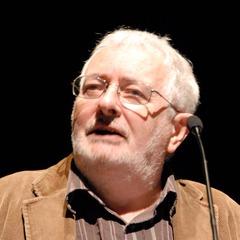
Quotessence
Home / Authors / Terry Eagleton
Terry Eagleton

Terry Eagleton Quotes

Literary critic

Filter quotes by topic

Famous Terry Eagleton Quotes

“So there is nothing inherently subversive about pleasure. On the contrary, as Karl Marx recognized, it is a thoroughly aristocratic creed. The traditional English gentleman was so averse to unpleasurable labour that he could not even be bothered to articulate properly. Hence the patrician slur and drawl, Aristotle believed that being human was something you had to get good at through constant practice, like learning Catalan or playing the bagpipes; whereas if the English gentleman was virtuous, as he occasionally deigned to be, his goodness was purely spontaneous. Moral effort was for merchants and clerks”

“What we have witnessed in our own time is the death of universities as centres of critique. Since Margaret Thatcher, the role of academia has been to service the status quo, not challenge it in the name of justice, tradition, imagination, human welfare, the free play of the mind or alternative visions of the future. We will not change this simply by increasing state funding of the humanities as opposed to slashing it to nothing. We will change it by insisting that a critical reflection on human values and principles should be central to everything that goes on in universities, not just to the study of Rembrandt or Rimbaud.”

“We like to think of individuals as unique. Yet if this is true of everyone, then we all share the same quality, namely our uniqueness. What we have in common is the fact that we are all uncommon. Everybody is special, which means that nobody is. The truth, however, is that human beings are uncommon only up to a point. There are no qualities that are peculiar to one person alone. Regrettably, there could not be a world in which only one individual was irascible, vindictive or lethally aggressive. This is because human beings are not fundamentally all that different from each other, a truth postmodernists are reluctant to concede. We share an enormous amount in common simply by virtue of being human, and this is revealed by the vocabularies we have for discussing human character. We even share the social processes by which we come to individuate ourselves.”

“In the pragmatist, streetwise climate of advanced postmodern capitalism, with its scepticism of big pictures and grand narratives, its hard-nosed disenchantment with the metaphysical, 'life' is one among a whole series of discredited totalities. We are invited to think small rather than big – ironically, at just the point when some of those out to destroy Western civilization are doing exactly the opposite. In the conflict between Western capitalism and radical Islam, a paucity of belief squares up to an excess of it. The West finds itself faced with a full-blooded metaphysical onslaught at just the historical point that it has, so to speak, philosophically disarmed. As far as belief goes, postmodernism prefers to travel light: it has beliefs, to be sure, but it does not have faith.”

“Statements of fact are after all statements, which presumes a number of questionable judgements: that those statements are worth making, perhaps more worth making than certain others, that I am the sort of person entitled to make them and perhaps able to guarantee their truth, that you are the kind of person worth making them to, that something useful is accomplished by making them, and so on.”

“All of our descriptive statements move within an often invisible network of value-categories, and indeed without such categories we would have nothing to say to each other at all. It is not just as though we have something called factual knowledge which may then be distorted by particular interests and judgements, although this is certainly possible; it is also that without particular interests we would have no knowledge at all, because we would not see the point of bothering to get to know anything. Interests are constitutive of our knowledge, not merely prejudices which imperil it. The claim that knowledge should be 'value-free' is itself a value-judgement.”

“For the liberal humanist legacy to which Ditchkins is in indebted, love can really be understood only in personal terms. It is not an item in his political lexicon, and would sound merely embarrassing were it to turn up there. For the liberal tradition, what seems to many men and women to lie at the core of human existence has a peripheral place in the affairs of the world, however vital a role it may play in the private life. The concept of political love, one imagines would make little sense to Ditchkins. Yet something like this is the ethical basis for socialism. It is just that it is hard to see what this might mean in a civilization where love has been almost wholly reduced to the erotic, romantic, or domestic. Ditchkins writes as he does partly because a legacy which offers an alternative to the liberal heritage on this question is today in danger of sinking without trace.”

“Our system is run by a set of dreamers who call themselves realists. To expect the future to be different is not of course to maintain that it will be better. It might be a great deal worse. The point is that history is malleable enough for us to choose. No sooner had the political theorists of the 1990s proclaimed that history was at an end than two aircraft slammed into the World Trade Center, and a whole new historical narrative began to unfold. History may not have been improved by this development, but it certainly didn’t stand still.”

“Marx was troubled by the question of why ancient Greek art retained an ‘eternal charm’, even though the social conditions which produced it had long passed; but how do we know that it will remain ‘eternally’ charming, since history has not yet ended? Let us imagine that by dint of some deft archaeological research we discovered a great deal more about what ancient Greek tragedy actually meant to its original audiences, recognized that these concerns were utterly remote from our own, and began to read the plays again in the light of this deepened knowledge. One result might be that we stopped enjoying them. We might come to see that we had enjoyed them previously because we were unwittingly reading them in the light of our own preoccupations; once this became less possible, the drama might cease to speak at all significantly to us. The fact that we always interpret literary works to some extent in the light of our own concerns - indeed that in one sense of ‘our own concerns’ we are incapable of doing anything else - might be one reason why certain works of literature seem to retain their value across the centuries. It may be, of course, that we still share many preoccupations with the work itself; but it may also be that people have not actually been valuing the ‘same’ work at all, even though they may think they have. ‘Our’ Homer is not identical with the Homer of the Middle Ages, nor ‘our’ Shakespeare with that of his contemporaries; it is rather that different historical periods have constructed a ‘different’ Homer and Shakespeare for their own purposes, and found in these texts elements to value or devalue, though not necessarily the same ones. All literary works, in other words, are ‘rewritten’, if only unconsciously, by the societies which read them; indeed there is no reading of a work which is not also a ‘re-writing’. No work, and no current evaluation of it, can simply be extended to new groups of people without being changed, perhaps almost unrecognizably, in the process; and this is one reason why what counts as literature is a notably unstable affair.”

“The inmates of Belsen or Buchenwald did not have to die hallowed by their sufferings, or with a brave resignation to their fate, or conscious of themselves as world-historical figures, or exulting in the thought that, though they themselves might perish, the human spirit itself is invincible, in order to earn the title of tragic. They simply had to be men and women in an intolerable situation. The banal truth is that one does not need to do anything in particular to qualify as a tragic protagonist. One simply has to be a human being at the end of one’s tether. One does not have to be virtuous, only virtuous enough not to deserve the wretchedness to which you are reduced.”

“Truth is ugliness, not beauty. If the artist is to redeem the whole of reality, whether as naturalistic novelist or demonic post Baudelairean poet, he must undergo what Yeats calls the baptism of the gutter, refusing orthodox moral distinctions so as to become imaginatively at one with the slime and refuse of human existence. Only in this way will he be able to gather the excremental into the eternal. It is an aesthetic version of crucifixion and resurrection, one which invests the poet with a certain aura of sanctity. Yet he is also sacred in the ancient sense of being both blessed and cursed. To live by imaginative empathy is to be bereft of a self; to be without a self is to exist as a kind of nothingness; and nothingness is unnervingly close to evil.”

“Children make the best theorists, since they have not yet been educated into accepting our routine social practices as "natural," and so insist on posing to those practices the most embarrassingly general and fundamental questions, regarding them with a wondering estrangement which we adults have long forgotten. Since they do not yet grasp our social practices as inevitable, they do not see why we might not do things differently.”

“The quarrel between science and religion, then, is not a matter of how universe came about, or which approach can provide the best "explanation" for it. It is a disagreement about how far back one has to go, though not in the chronological sense. For theology, science does not start far back enough - not in the sense that it fails to posit a Creator, but in the sense that it does not ask questions such as why there is anything in the first place, or why what we do have is actually intellible to us. Perhaps these are phony questions anyway; some philosophers certainly think so. But theologians, as Rowan Williams has argued, are interested in the question of why we ask for explanations at all, or why we assume that the universe hangs together in a way that makes explanations possible. Where do our notions of explanation, regularity, and intelligibility come from? How do we explain rationality and intelligibility themselves, or is this question either superfluous or too hard to answer? Can we not account for rationality because to do so is to presuppose it? Whatever we think of such queries, science as we know it is possible only because the world displays a certain internal order and coherence - possible, that is to say, for roughly aesthetic reasons.”

“What rationalism from d’Alembert to Dawkins is loath to acknowledge is that human rationality is a corporeal one. We think as we do roughly because of the kind of bodies we have, as Thomas Aquinas noted. Reason is authentically rational only when it is rooted in what lies beyond itself. It must find its home in what is other than reason, which is not to say in what is inimical to it. Any form of reason which grasps itself purely in terms of ideas, and then fumbles for some less cerebral way in which to connect with the sensory world, is debilitated from the outset.”

“Yet only the economic in the narrow sense will allow us to get beyond the economic. By redeploying the resources capitalism has so considerately stored up for us, socialism can allow the economic to take more of a backseat. It will not evaporate, but it will become less obtrusive. To enjoy a sufficiency of goods means not to have to think about money all the time. It frees us for less tedious pursuits. Far from being obsessed with economic matters, Marx saw them as a travesty of true human potential. He wanted society where the economic no longer monopolised so much time and energy. That our ancestors should have been so preoccupied with material matters is understandable. When you can produce only a slim economic surplus, or scarcely any surplus at all, you will perish without ceaseless hard labour. Capitalism, however, generates the sort of surplus that really could be used to increase leisure on a sizeable scale. The irony is that it creates this wealth in a way that demands constant accumulation and expansion, and thus constant labour. It also creates it in ways that generate poverty and hardship. It is a self-thwarting system. As a result, modern men and women, surrounded by an affluence unimaginable to hunter-gatherers, ancient slaves or feudal serfs, end up working as long and hard as these predecessors ever did. Marx's work is all about human enjoyment. The good life for him is not one of labour but of leisure.”

“If this constant sliding and hiding of meaning were true of conscious life, then we would of course never be able to speak coherently at all. If the whole of language were present to me when I spoke, then I would not be able to articulate anything at all. The ego, or consciousness, can therefore only work by repressing this turbulent activity, provisionally nailing down words on to meanings. Every now and then a word from the unconscious which I do not want insinuates itself into my discourse, and this is the famous Freudian slip of the tongue or parapraxis. But for Lacan all our discourse is in a sense a slip of the tongue: if the process of language is as slippery and ambiguous as he suggests, we can never mean precisely what we say and never say precisely what we mean. Meaning is always in some sense an approximation, a near-miss, a part-failure, mixing non-sense and non-communication into sense and dialogue.”

“What it means to be a ‘better person’, then, must be concrete and practical — that is to say, concerned with people’s political situations as a whole — rather than narrowly abstract, concerned only with the immediate interpersonal relations which can be abstracted from this concrete whole. It must be a question of political and not only of ‘moral’ argument: that is to say, it must be genuine moral argument, which sees the relations between individual qualities and values and our whole material conditions of existence. Political argument is not an alternative to moral preoccupations: it is those preoccupations taken seriously in their full implications.”

“The ‘healthy’ sign, for Barthes, is one which draws attention to its own arbitrariness—which does not try to palm itself off as ‘natural’ but which, in the very moment of conveying a meaning, communicates something of its own relative, artificial status as well. …Signs which pass themselves off as natural, which offer themselves as the only conceivable way of viewing the world, are by that token authoritarian and ideological. It is one of the functions of ideology to ‘naturalize’ social reality, to make it seem as innocent and unchangeable as Nature itself. Ideology seeks to convert culture into Nature, and the ‘natural’ sign is one of its weapons. Saluting a flag, or agreeing that Western democracy represents the true meaning of the word ‘freedom’, become the most obvious, spontaneous responses in the world. Ideology, in this sense, is a kind of contemporary mythology, a realm which has purged itself of ambiguity and alternative possibility.”

“It is of our nature to exceed ourselves. Overflowing the mesaure is built into what we are. So, too, is rejoicing in this superabundance for its own sake. Yet too lavish an excess, like too vaulting an ambition, may lead us to overreach ourselves and bring ourselves to nothing. Like Lady Macbeh, one can forget that constraints (the demands of kinship or hospitality, for example) are costitutive of the self, not simply obstacles to its expression.”

“What Althusser does… is to rethink the concept of ideology in terms of Lacan’s ‘imaginary’. For the relation of an individual subject to society as a whole in Althusser’s theory is rather like the relation of the small child to his or her mirror-image in Lacan’s. In both cases, the human subject is supplied with a satisfyingly unified image of selfhood by identifying with an object which reflects this image back to it in a closed, narcissistic circle. In both cases, too, this image involves a misrecognition, since it idealizes the subject’s real situation. The child is not actually as integrated as its image in the mirror suggests; I am not actually the coherent, autonomous, self generating subject I know myself to be in the ideological sphere, but the ‘decentred’ function of several social determinants. Duly enthralled by the image of myself I receive, I subject myself to it; and it is through this ‘subjection’ that I become a subject.”

“It was possible to explore the 'great tradition' of the English novel and believe that in doing so you were addressing questions of fundamental value -- questions which were of vital relevance to the lives of men and women wasted in fruitless labour in the factories of industrial capitalism. But it was also conceivable that you were destructively cutting yourself off from such men and women, who might be a little slow to recognize how a poetic enjambement enacted a movement of physical balancing.”

“Language, the unconscious, the parents, the symbolic order: these terms in Lacan are not exactly synonymous, but they are intimately allied. They are sometimes spoken of by him as the ‘Other’ — as that which like language is always anterior to us and will always escape us, that which brought us into being as subjects in the first place but which always outruns our grasp. We have seen that for Lacan our unconscious desire is directed towards this Other, in the shape of some ultimately gratifying reality which we can never have; but it is also true for Lacan that our desire is in some way always received from the Other too. We desire what others — our parents, for instance — unconsciously desire for us; and desire can only happen because we are caught up in linguistic, sexual and social relations — the whole field of the ‘Other’ — which generate it.”

“[B]y reinterpreting Freudianism in terms of language, a pre-eminently social activity, Lacan permits us to explore the relations between the unconscious and human society. One way of describing his work is to say that he makes us recognize that the unconscious is not some kind of seething, tumultuous, private region ‘inside’ us, but an effect of our relations with one another. The unconscious is, so to speak, ‘outside’ rather than ‘within’ us — or rather it exists ‘between’ us, as our relationships do.”

“In conscious life, we achieve some sense of ourselves as reasonably unified, coherent selves, and without this action would be impossible. But all this is merely at the ‘imaginary’ level of the ego, which is no more than the tip of the iceberg of the human subject known to psychoanalysis. The ego is function or effect of a subject which is always dispersed, never identical with itself, strung out along the chains of the discourses which constitute it. There is a radical split between these two levels of being — a gap most dramatically exemplified by the act of referring to myself in a sentence. When I say ‘Tomorrow I will mow the lawn,’ the ‘I’ which I pronounce is an immediately intelligible, fairly stable point of reference which belies the murky depths of the ‘I’ which does the pronouncing. The former ‘I’ is known to linguistic theory as the ‘subject of the enunciation’, the topic designated by my sentence; the latter ‘I’, the one who speaks the sentence, is the ‘subject of the enunciating’, the subject of the actual act of speaking. In the process of speaking and writing, these two ‘I’s’ seem to achieve a rough sort of unity; but this unity is of an imaginary kind. The ‘subject of the enunciating’, the actual speaking, writing human person, can never represent himself or herself fully in what is said: there is no sign which will, so to speak, sum up my entire being. I can only designate myself in language by a convenient pronoun. The pronoun ‘I’ stands in for the ever-elusive subject, which will always slip through the nets of any particular piece of language; and this is equivalent to saying that I cannot ‘mean’ and ‘be’ simultaneously. To make this point, Lacan boldly rewrites Descartes’s ‘I think, therefore I am’ as: ‘I am not where I think, and I think where I am not.”

“Lacan, as we have seen in our discussion of Freud, regards the unconscious as structured like a language. This is not only because it works by metaphor and metonymy: it is also because, like language itself for the post-structuralists, it is composed less of signs — stable meanings — than of signifiers. If you dream of a horse, it is not immediately obvious what this signifies: it may have many contradictory meanings, may be just one of a whole chain of signifiers with equally multiple meanings. The image of the horse, that is to say, is not a sign in Saussure’s sense - it does not have one determined signified tied neatly to its tail - but is a signifier which may be attached to many different signifieds, and which may itself bear the traces of the other signifiers which surround it. (I was not aware, when I wrote the above sentence, of the word-play involved in ‘horse’ and ‘tail’: one signifier interacted with another against my conscious intention.) The unconscious is just a continual movement and activity of signifiers, whose signifieds are often inaccessible to us because they are repressed. This is why Lacan speaks of the unconscious as a ‘sliding of the signified beneath the signifier’, as a constant fading and evaporation of meaning, a bizarre ‘modernist’ text which is almost unreadable and which will certainly never yield up its final secrets to interpretation.”

“If men and women need freedom and mobility, they also need a sense of tradition and belonging. There is nothing retrograde about roots. The postmodern cult of the migrant, which sometimes succeeds in making migrants sound even more enviable than rock stars, is a good deal too supercilious in this respect. It is a hangover from the modernist cult of the exile, the Satanic artist who scorns the suburban masses and plucks an elitist virtue out of his enforced dispossession. The problem at the moment is that the rich have mobility while the poor have locality. Or rather, the poor have locality until the rich get their hands on it. The rich are global and the poor are local - though just as poverty is a global fact, so the rich are coming to appreciate the benefits of locality.”

“A virulent form of utopianism has indeed afflicted the modern age, but its name is not Marxism. It is the crazed motion that a single global system known as the free market can impose itself on the most diverse cultures and economies and cure all their ills. The purveyors of this totalitarian fantasy are not to be found hiding scar-faced and sinisterly soft-spoken in underground bunkers like James Bond villains. They are to be seen dining at upmarket Washington restaurants and strolling on Sussex estates.”

“Another anti-theoretical stratagem is to claim that in order to launch some fundamental critique of our culture, we would need to be standing at some Archimedean point beyond it. What this fails to see is that reflecting critically on our situation is part of our situation. It is a feature of the peculiar way we belong to the world. It is not some impossible light-in-the-refrigerator attempt to scrutinize ourselves when we are not there. Curving back on ourselves is as natural to us as it is to cosmic space or a wave of the sea. It does not entail jumping out of our own skin. Without such self-monitoring we would not have survived as a species.”

“Reading is not a straightforward linear movement, a merely cumulative affair: our initial speculations generate a frame of reference within which to interpret what comes next, but what comes next may retrospectively transform our original understanding, highlighting some features of it and backgrounding others.”

“What was needed was a literary theory which, while preserving the formalist bent of New Criticism, its dogged attention to literature as aesthetic object rather than social practice, would make something a good deal more systematic and 'scientific' out of all this. The answer arrived in 1957, in the shape of the Canadian Northrop Fryes mighty 'totalization' of all literary genres, Anatomy of Criticism .”