“In conscious life, we achieve some sense of ourselves as reasonably unified, coherent selves, and without this action would be impossible. But all this is merely at the ‘imaginary’ level of the ego, which is no more than the tip of the iceberg of the human subject known to psychoanalysis. The ego is function or effect of a subject which is always dispersed, never identical with itself, strung out along the chains of the discourses which constitute it. There is a radical split between these two levels of being — a gap most dramatically exemplified by the act of referring to myself in a sentence. When I say ‘Tomorrow I will mow the lawn,’ the ‘I’ which I pronounce is an immediately intelligible, fairly stable point of reference which belies the murky depths of the ‘I’ which does the pronouncing. The former ‘I’ is known to linguistic theory as the ‘subject of the enunciation’, the topic designated by my sentence; the latter ‘I’, the one who speaks the sentence, is the ‘subject of the enunciating’, the subject of the actual act of speaking. In the process of speaking and writing, these two ‘I’s’ seem to achieve a rough sort of unity; but this unity is of an imaginary kind. The ‘subject of the enunciating’, the actual speaking, writing human person, can never represent himself or herself fully in what is said: there is no sign which will, so to speak, sum up my entire being. I can only designate myself in language by a convenient pronoun. The pronoun ‘I’ stands in for the ever-elusive subject, which will always slip through the nets of any particular piece of language; and this is equivalent to saying that I cannot ‘mean’ and ‘be’ simultaneously. To make this point, Lacan boldly rewrites Descartes’s ‘I think, therefore I am’ as: ‘I am not where I think, and I think where I am not.”
Quote by Terry Eagleton
Work
Literary Theory: An Introduction
This book serves as an introductory resource for understanding the various theories and methodologies that shape the study of literature. It covers key concepts such as structuralism, postmodernism, and deconstruction, offering insights into the analysis of literary texts and their cultural contexts. more
Author
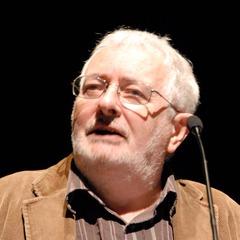
Terry Eagleton
Terry Eagleton is a renowned British literary critic, known for his research on Marxist literary theory. His work spans a wide range of literary and theoretical topics, influencing cultural studies and political commentary as well. more
You May Also Like
Source: Literary Theory: An Introduction
Source: The Sublime Object of Ideology
Source: Nice Girls Don't Have Fangs
Source: Nice Girls Don't Have Fangs
Source: Nice Girls Don't Have Fangs
Source: Nice Girls Don't Have Fangs
Source: Nice Girls Don't Have Fangs
Source: Nice Girls Don't Have Fangs
Source: Nice Girls Don't Have Fangs