Quotessence
Home / Quotes / Quote by Sophocles

Quote by Sophocles

Work

Antigone

This renowned work explores themes of justice, morality, and the conflict between individual conscience and the state. It tells the story of Antigone, who defies the king's decree and buries her brother, leading to a series of tragic events. more

Author

Sophocles
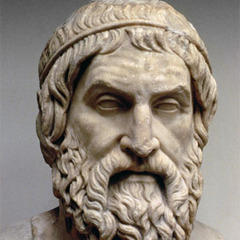
Sophocles

Sophocles, born in 498 BC and died in 406 BC, was a renowned Greek tragic playwright. He is one of the three greatest tragic poets of ancient Greece, alongside Aeschylus and Euripides. Sophocles' works profoundly revealed the complexity of human nature and social contradictions, exerting a profound influence on subsequent drama. more

You May Also Like

“The issue of race, however, has been with us since our earliest beginnings as a nation. I believe it is even deeper and sharper than the other points of contention. It has bred fears, myths, and violence over centuries. It is the source of dark and dangerous irrationality, a current of social pathology running through our history and dimming our brighter achievements. Most of the time the reservoir of racism remains stagnant. But--and this has been true historically for most societies--when major economic, social, or political crises arise, the backwaters are stirred and latent racial hostility comes to the surface. Scapegoats must be found, simple targets substituted for complex problems. The frustration and insecurity generated by these problems find an outlet in notions of racial superiority and inferiority.”

“Oftentimes, the scapegoat feels worthless and powerless. After being beaten down, year after year, we have a strong sense of false guilt. Unconsciously, we take the narcissist’s guilt as if it were our own. As if it were our fault. As if we are deserving of mental torture and physical abuse.”

“The rite, the becoming-animal of the scapegoat clearly illustrates this: a first expiatory animal is sacrificed, but a second is driven away, sent out into the desert wilderness. In the signifying regime, the scapegoat represents a new form of increasing entropy in the system of signs: it is charged with everything that was "bad" in a given period, that is, everything that resisted signifying signs, everything that eluded the referral from sign to sign through the different circles; it also assumes everything that was unable to recharge the signifier as its center and carries off everything that spills beyond the outermost circle.”

“The biggest hurdle most scapegoats face is the fear of doing something wrong by going grey rock, no contact, or upsetting the narcissist if you distance yourself. You walk on eggshells. You don’t feel safe. You don’t know from one minute to the next how the narcissist will react to you. At any moment, they can explode!”

“Do you want to know what General Putnam is thinking? It’s this. He’s thinking that he can’t win the war if he doesn’t keep the people on his side. He’s thinking that he can’t keep the people on his side if the troops are running amok among the civilian population—raping the women, stealing cattle, burning houses. He is determined to scare the wits out of the troops to keep them in line. And he’s thinking that it doesn’t matter very much who he executes to do it. So many men have died, so many mothers have wept, so many brothers and sisters have cried. He is thinking that in the long run if he executes somebody, he’ll shorten the war and save more lives. It doesn’t matter to him very much who he executes; one man’s agony is like another’s, one mother’s tears are no wetter than anybody else’s. And that’s why he’s going to have Sam shot.”

“Some people know that if they can only find the people responsible for all the chaos and punish them, stop them, kill them, then all will be well again. Hunting for scapegoats is always popular in times of serious trouble. So is hunting for the great leader who will restore prosperity and stability. Some people know that that's the answer. If they could just find the strong, powerful leader that they need, all would be well. And, unhappily for them, they do find such a leader. That leader has his own answers. He turns his true believers--his thugs--loose on those he chooses as scapegoats and he looks around for an external enemy to use as an even bigger scapegoat and a diversion from the reality that he doesn't really know what to do.... Sometimes the only thing more dangerous than frightened, confused, desperate people looking for solutions is frightened, confused, desperate people finding and settling for truly bad solutions.”