Quotessence
Home / Quotes / Quote by Winston Churchill

Quote by Winston Churchill

“...But the Mahommedan religion increases, instead of lessening, the fury of intolerance. It was originally propagated by the sword, and ever since, its votaries have been subject, above the people of all other creeds, to this form of madness. In a moment the fruits of patient toil, the prospects of material prosperity, the fear of death itself, are flung aside. The more emotional Pathans are powerless to resist. All rational considerations are forgotten. Seizing their weapons, they become Ghazis—as dangerous and as sensible as mad dogs: fit only to be treated as such. While the more generous spirits among the tribesmen become convulsed in an ecstasy of religious bloodthirstiness, poorer and more material souls derive additional impulses from the influence of others, the hopes of plunder and the joy of fighting. Thus whole nations are roused to arms. Thus the Turks repel their enemies, the Arabs of the Soudan break the British squares, and the rising on the Indian frontier spreads far and wide. In each case civilisation is confronted with militant Mahommedanism. The forces of progress clash with those of reaction. The religion of blood and war is face to face with that of peace.”

Quote by Winston Churchill

Work

The Story of the Malakand Field Force

This book provides a detailed narrative of the Malakand Field Force's expedition, offering insights into the military tactics and the social and political context of the time. more

Author
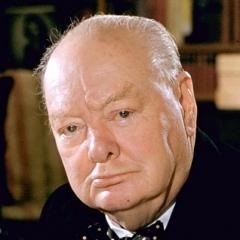
Winston Churchill
Winston Churchill

Winston Churchill, a former Prime Minister of the United Kingdom, was a statesman, historian, writer, and orator. He led the British people in resisting Nazi Germany during World War II and became a national hero. Churchill is renowned for his unique oratory style and steadfast political stance. more

You May Also Like

“...though leaving him always to remark, portentously, on his probably having formed a relation, his probably enjoying a consciousness, unique in the experience of man. People enough, first and last, had been in terror of apparitions, but who had ever before so turned the tables and become himself, in the apparitional world, an incalculable terror? He might have found this sublime had he quite dared to think of it; but he didn't too much insist, truly, on that side of his privilege.”

“He looked sharply towards the pollarded trees. 'Yes, just there,' he said. 'I saw it plainly, and equally plainly I saw it not. And then there's that telephone of yours.' I told him now about the ladder I had seen below the tree where he saw the dangling rope. 'Interesting,' he said, 'because it's so silly and unexpected. It is really tragic that I should be called away just now, for it looks as if the - well, the matter were coming out of the darkness into a shaft of light. But I'll be back, I hope, in thirty-six hours. Meantime, do observe very carefully, and whatever you do, don't make a theory. Darwin says somewhere that you can't observe without theory, but to make a theory is a great danger to an observer. It can't help influencing your imagination; you tend to see or hear what falls in with your hypothesis. So just observe; be as mechanical as a phonograph and a photographic lens.' Presently the dog-cart arrived and I went down to the gate with him. 'Whatever it is that is coming through, is coming through in bits,' he said. 'You heard a telephone; I saw a rope. We both saw a figure, but not simultaneously nor in the same place. I wish I didn't have to go.' I found myself sympathizing strongly with this wish, when after dinner I found myself with a solitary evening in front of me, and the pledge to 'observe' binding me. It was not mainly a scientific ardour that prompted this sympathy and the desire for independent combination, but, quite emphatically, fear of what might be coming out of the huge darkness which lies on all sides of human experience. I could no longer fail to connect together the fancied telephone bell, the rope, and the ladder, for what made the chain between them was the figure that both Philip and I had seen. Already my mind was seething with conjectural theory, but I would not let the ferment of it ascend to my surface consciousness; my business was not to aid but rather stifle my imagination. ("Expiation")”

“Living in the wake of slavery is haunting, and to experience this haunting is to be nothing less than traumatized. Still, it is possible to heal from trauma, or come to terms with it. At first, we try to block out the horrors of the past - to ignore them, to pretend they are not there. The next step is to acknowledge the past and its harm, even as it triggers us. We try to avoid looking at it too closely. But the ghosts are everywhere; they have been waiting for us all along.”

“When Lamb turned around and saw the girl working her legs and sweating and squinting into the sun - Christ, what can a man say? It was like his bones had been wired tight all his life and seeing her that way, everything suddenly went slack, his mind unwinding like a spool of loose thread. What a man she rendered him, simply by being a girl who could be picked up and moved: what he wanted to be, what he ought to be, what was most unintelligible and unplanned and true in him when he carried her out of her fettered world to this. How powerful she was as long as she asserted no will of her own.”