Quotessence
Home / Quotes / Quote by Tariq Ali

Quote by Tariq Ali

Work

The Obama Syndrome: Surrender at Home, War Abroad

This book analyzes the foreign and domestic policies of Barack Obama's presidency, focusing on the administration's approach to international relations and domestic issues. more

Author
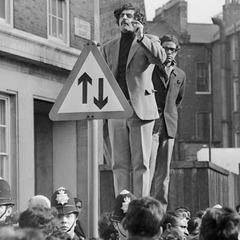
Tariq Ali
Tariq Ali

Tariq Ali is a British writer born on October 21, 1943. His works span a variety of fields including history, politics, and literature, known for his incisive analysis and critical thinking. more

You May Also Like

“Through their donations and work for voluntary organizations, the charitable rich exert enormous influence in society. As philanthropists, they acquire status within and outside of their class. Although private wealth is the basis of the hegemony of this group, philanthropy is essential to the maintenance and perpetuation of the upper class in the United States. In this sense, nonprofit activities are the nexus of a modern power elite.”

“cultural cringe which prevents other people from challenging them. the Italian philosopher Antonio Gramsci used the term ‘cultural hegemony’ to describe the way in which ideas and concepts which benefit a dominant class are universalised. they become norms, adopted whole and unexamined, which shape our thinking”

“Another way, and this applies to all the areas covered under this section, is by practicing what I call intellectual boycotting, which I simply define as: boycotting any intellectual or writer canonized and imposed on us through Western academic institutions, media, or any other institution with money and power. Note that this doesn’t mean not to read them, but rather, to read and cite them (if necessary) with caution, and preferably with the intent of debunking or exposing their silences and blind spots rather than using them as a compass to evaluate other forms of knowledge.”

“I personally believe (and I know many readers will find this controversial) that we should never engage with any writers or scholars whose work is intentionally Euro-American centered and purposely ignores or refuses to engage with knowledge produced by thinkers outside the West. In other words, in knowledge production, reciprocate treatment (whether in engagement or citation) can be effective in challenging and changing the rules of the game.”

“Hiba S. is one of the pioneer Iraqi women academics and authors in the field of media and journalism, currently exiled in Amman. During a visit to her office in summer 2014, Hiba shared that the early days of the occupation in 2003 were the most difficult she had ever experienced. She recollected: ‘I was sitting in my garden smoking when I suddenly saw a huge American tank driving through the street. I saw a Black soldier on the top of the tank. He looked at me and did the victory sign with his fingers. Had I had a pistol in my hand, I would have immediately shot myself in the head right then and there. The pain I felt upon seeing that image is indescribable. I felt as though all the years we had spent building our country, educating our students to make them better humans were gone with the wind.’ Hiba’s description carries strong feelings of loss, defeat, and humiliation. Also significant in her narrative is that the first American soldier she encountered in post-invasion Iraq was a Black soldier making the victory sign. This is perhaps one of the most ironic and paradoxical images of the occupation. A Black soldier from a historically and consistently oppressed group in American society, who, one might imagine had no choice but to join the military, coming to Iraq and making the victory sign to a humiliated Iraqi academic whose country was ravaged by war. In a way, this image is worthy of a long pause. It is an encounter of two oppressed and defeated groups of people—Iraqis and African Americans meeting as enemies in a warzone. But, if one digs deeper, are these people really 'enemies' or allies struggling against the same oppressors? Do the real enemies ever come to the battlefield? Or do they hide behind closed doors planning wars and invasions while sending other 'oppressed' and 'diverse' faces to the battlefield to fight wars on their behalf? Hiba then recalled the early months of the occupation at the University of Baghdad where she taught. She noted that the first thing the Coalition Provisional Authority (CPA) tried to do was to change the curriculum Iraqi academics had designed, taught, and improved over the decades. While the Americans succeeded in doing this at the primary and high school levels, Hiba believed that they did not succeed as much at the university level. Iraqi professors knew better than to allow the 'Americanization of the curriculum' to take place. 'We knew the materials we were teaching were excellent even compared to international standards,' she said. 'They [the occupiers] tried to immediately inject subjects like "democracy" and "human rights" as if we Iraqis didn’t know what these concepts meant.' It is clear from Hiba’s testimony, also articulated by several other interviewees, that the Iraqi education system was one of the occupying forces’ earliest targets in their desire to reshape and restructure Iraqi society and peoples’ collective consciousness.”