Quotessence
Home / Quotes / Quote by Carl Sagan

Quote by Carl Sagan

“Los libros lo cambiaron todo. Los libros, que se pueden comprar a bajo coste, nos permiten preguntarnos por el pasado con gran precisión, aprovechar la sabiduría de nuestra especie, entender el punto de vista de otros, y no solo de los que están en el poder; contemplar -con los mejores maestros- los conocimientos dolorosamente extraídos de la naturaleza por las mentes más grandes que jamás existieron, en todo el planeta y a lo largo de toda nuestra historia. Permiten que gente que murió hace tiempo hable dentro de nuestras cabezas. Los libros nos pueden acompañar a todas partes. Los libros son pacientes cuando nos cuesta entenderlos, nos permiten repasar las partes difíciles tantas veces como queramos y nunca critican nuestros errores. Los libros son la clave para entender el mundo y participar en una sociedad democrática.”

Quote by Carl Sagan

Work

The Demon-Haunted World: Science as a Candle in the Dark

In this seminal work, the author delves into the principles of scientific inquiry, critical analysis, and evidence-based reasoning. The book serves as a guide to discerning fact from fiction, advocating for the importance of skepticism and rationality in understanding the natural world. more

Author
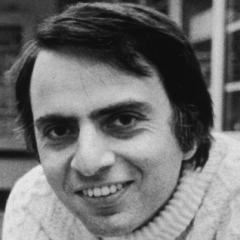
Carl Sagan
Carl Sagan

Carl Sagan was an American astronomer, cosmologist, author, and science communicator, born on November 9, 1934, in Brooklyn, New York. He is renowned for his profound research into the cosmos and his dedication to popularizing science. Sagan proposed numerous theories about the origin of the universe and life, and he made complex scientific knowledge accessible to the public with his unique perspective and clear, engaging writing style. more

You May Also Like

“Sarah (Winnemucca) is best known for her 1883 autobiography, Life among the Piutes: Their Wrongs and Theirs Claims, the first memoir writen and published by a Native American woman. Her story begins; 'I was born somewhere near 1844, but am not sure of the precise time. I was a very small child when the first white people came to our country. They came like a lion, yes, like a roaring lion, and have continued to do so ever since, and I have never forgotten their first coming.”

“Usually, after the lion came the leopard and sometimes the buzz of the tsetse fly. These were easily obtained effects; and I explained to M. de Chagny that Erik imitated the roar of a lion on a long tabour or timbrel, with an ass's skin at one end. Over this skin he tied a string of catgut, which was fastened at the middle to another similar string passing through the whole length of the tabour. Erik had only to rub this string with a glove smeared with resin and, according to the manner in which he rubbed it, he imitated to perfection the voice of the lion or the leopard, or even the buzzing of the tsetse fly.”

“… o termo “rios voadores da Amazônia” designa a enorme quantidade de água processada pelas árvores e lançada na natureza em forma de umidade. – A selva funciona como uma gigantesca bomba d’água que capta água do solo e a lança na atmosfera em forma de vapor, e as correntes de ar se encarregam de espalhar pelo mundo. Uma única árvore de modestos 10 metros de altura transpira em média 300 litros de água por dia, e uma mais frondosa, com a copa mais avantajada, de 20 metros de diâmetro, pode liberar até 1.000 litros. Imaginem a quantidade de líquido precioso produzida pelos milhões e milhões de árvores da Amazônia. … Uma parte desse vapor se transforma em chuvas que caem sobre a própria floresta, a outra fica à mercê dos ventos. Estima-se que a quantidade de água transportada pelos rios voadores seja igual ou superior à vazão do rio Amazonas. São 200 mil metros cúbicos de água por segundo. Na prática, a maior parte dos rios voadores são direcionados pelos ventos para o oeste até o paredão de 5 mil metros de altura formado pela Cordilheira dos Andes. O resultado desse represamento gigantesco são as enormes precipitações de chuva e neve, que dão origem às nascentes de vários rios, entre eles a do próprio Amazonas. Outra parte é ricocheteada pelas montanhas para o interior do continente, e abastece fartamente de água o Centro-Oeste, o Sudeste e o Sul do continente. Esse fenômeno explica por que no restante do mundo, nessa mesma latitude, encontramos grandes desertos, enquanto na América do Sul predomina um clima muito favorável para a agricultura. A combinação da floresta tropical amazônica com a Cordilheira dos Andes forma um dos maiores celeiros do mundo. Sem floresta, não haveria rios voadores, a umidade cairia a níveis desérticos e o ar ficaria muito mais quente. Seria um completo desastre para o clima e para a agricultura brasileira e mundial.”

“In his comprehensive survey of romantic landscape lithographs, Jean Adhemar has demonstrated that these albums were made up of topographic prints in a picturesque mode, depicting both foreign and French scenes. While albums depicting foreign scenes were generally devoted to a single country, those showing French scenes usually took the form of regional albums that featured a department, a historic region (Normandy, Brittany), or a mountain range (the Pyrenees or the Jura). The importance they played may be gauged not only from the considerable number of albums that were published but also from the substantial editions that were printed, particularly of the albums that were published in Paris.”

“It is clear, therefore, that there is enough evidence of historical memory in India to render the line of investigation adopted here worth pursuing. It is true that Hindu India does not possess a sustained tradition of historiography of the kind we find in other ancient cultures such as Greece, Rome and China. Sometimes cultures exhibit such civilizational gaps. For instance, China has a long history, a history of warfare and chivalry as well, and of course a literary tradition right from Confucius onwards, but it did not produce an epic of the kind we find in Greece, Rome and India. One reason behind this histographic gap in India could be that historical events in ancient India were recorded on stone rather than paper. This renders the facts narrated above particularly signficant, as they are cut in stone. India has more than 90,000 inscriptions, most of which are still unread.”