Quotessence
Home / Quotes / Quote by Thomas Paine

Quote by Thomas Paine

“The story of the angel announcing what the church calls the immaculate conception, is not so much as mentioned in the books ascribed to Mark, and John; and is differently related in Matthew and Luke. The former says the angel, appeared to Joseph; the latter says, it was to Mary; but either Joseph or Mary was the worst evidence that could have been thought of; for it was others that should have testified for them, and not they for themselves. Were any girl that is now with child to say, and even to swear it, that she was gotten with child by a ghost, and that an angel told her so, would she be believed? Certainly she would not. Why then are we to believe the same thing of another girl whom we never saw, told by nobody knows who, nor when, nor where? How strange and inconsistent is it, that the same circumstance that would weaken the belief even of a probable story, should be given as a motive for believing this one, that has upon the face of it every token of absolute impossibility and imposture.”

Quote by Thomas Paine

Work

The age of reason

Pensado by Thomas Paine, this seminal text delves into the author's beliefs regarding the role of reason in understanding the world and its implications for religion and governance. It is a critical examination of the supernatural and the divine, advocating for a rational approach to understanding the universe. more

Author
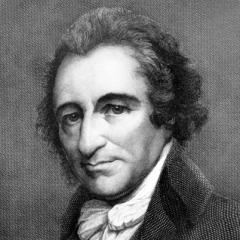
Thomas Paine
Thomas Paine

Thomas Paine, born on February 9, 1737, and died on June 8, 1809, was a prominent American writer, political figure, and philosopher during the American Revolutionary War. He is renowned for his radical democratic ideas and his contributions to the American independence movement. more

You May Also Like

“Obscenity in matters of faith, however wrapped up, is always a token of fable and imposture; for it is necessary to our serious belief in God, that we do not connect it with stories that run, as this does, into ludicrous interpretations. This story is, upon the face of it, the same kind of story as that of Jupiter and Leda, or Jupiter and Europa, or any of the amorous adventures of Jupiter; and shews, as is already stated in the former part of 'The Age of Reason,' that the Christian faith is built upon the heathen Mythology.”

“The rising influence of lay piety is particularly marked upon the Mariological controversies of the late medieval period. Two rival positions developed: the maculist position, which held that Mary was subject to original sin, in common with every other human being; and the immaculist position, which held that contrary view that Mary was in some way preserved from original sin, and was thus to be considered sinless. The maculist position was regarded as firmly established within the High Scholasticism of the thirteenth century. The veneration of the Virgin within popular piety, however, proved to have an enormously creative power that initially challenged, and subsequently triumphed over, the academic objections raised against it by university theologians.”

“But, being Himself at once God and man, His flesh and soul were and are holy - and beyond holy. God is holy, just as He was and is and shall be, and the Virgin is immaculate, without spot or stain, and so, too, was that rib which was taken from Adam. However, the rest of humanity, even though they are His brothers and kin according to the flesh, yet remained even as they were, of dust, and did not immediately become holy and sons of God.”

“But the work which most richly embroidered the gospel narratives and was destined to exert a tremendous influence on later Mariology was the Protoevangelium of James. Written for Mary's glorification, this described her divinely ordered birth when her parents, Joachim and Anna, were advanced in years, her miraculous infancy and childhood, and her dedication to the Temple, where her parents had prayed that God would give her 'a name renowned for ever among all generations'. It made the point that when she was engaged to Joseph he was already an elderly widower with sons of his own; and it accumulated evidence both that she had conceived Jesus without sexual intercourse and that her physical nature had remained intact when she bore Him. These ideas were far from being immediately accepted in the Church at large. Iranaeus, it is true, held that Mary's childbearing was exempt from physical travail, as did Clement of Alexandria (appealing to the Protoevangelium of James). Tertullian, however, repudiated the suggestion, finding the opening of her womb prophesied in Exodus 13, 2, and Origen followed him and argued that she had needed the purification prescribed by the Law. On the other hand, while Tertullian assumed that she had had normal conjugal relations with Joseph after Jesus's birth, the 'brethren of the Lord' being his true brothers, Origen maintained that she had remained a virgin for the rest of her life('virginity post partum') and that Jesus's so-called brothers were sons of Joseph but not by her...In contrast to the later belief in her moral and spiritual perfection, none of these theologians had the least scruple about attributing faults to her. Irenaeus and Tertullian recalled occasions on which, as they read the gospel stories, she had earned her Son's rebuke, and Origen insisted that, like all human beings, she needed redemption from her sins; ...”

“She gently placed her palm on my wounded shoulder and the warmth of her hand did nearly as much to soothe the ache as did the ointment. If only she would continue touching me, allow us to forge something new together from the broken pieces of our past. Her willing presence in my life would be far more healing than any balm”