Quotessence
Home / Quotes / Quote by Friedrich Engels

Quote by Friedrich Engels

“True, t is only individuals who starve, but what security has the working-man that it may not be his turn tomorrow? Who assures him employment, who vouches for it that, if for any reason or no reason his lord and master discharges him tomorrow, he can struggle along with those dependant upon him, until he may find some one else 'to give him bread'? Who guarantees that willingness to work shall suffice to obtain work, that uprightness, industry, thrift, and the rest of the virtues recommended by the bourgeoisie, are really his road to happiness? No one. He knows that every breeze that blows, every whim of his employer, every bad turn of trade may hurl him back into the fierce whirlpool from which he has temporarily saved himself, and in which it is hard and often impossible to keep his head above water. He knows that, though he may have the means of living today, it is very uncertain whether he shall tomorrow.”

Quote by Friedrich Engels

Author
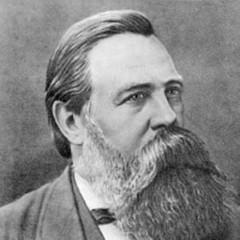
Friedrich Engels
Friedrich Engels

Friedrich Engels was a German philosopher, politician, economist, and revolutionary, co-founder of communist theory with Karl Marx. He was born on November 28, 1820, and died on August 5, 1895. more

You May Also Like

“The urban capitalists and the bourgeoisie differ in linguistic habits and dress from the workers. They don't live together in one integrated society, but as two separate societies that speak different languages both literally and metaphorically. The urban capitalists do not know the life led by workers. Workers experience hardships that are unheard of amongst villagers and these evoke malice in the urban workers, easily stirred by union leaders who use them to ride to power. Villagers are different. Teaching the villagers cannot easily change what they have inherited from the environment and the past they have known and in which they have grown up. The village entrepreneur wore only a sarong in the past. Some of them wore a sarong and slung another over a shoulder. The poor villager's dress is also a sarong. The village entrepreneur speaks Sinhalese, which is the language of the poor villager too. On the day of the traditional New Year, the children of both the rich and the poor in the village eat together and play together in the homes of the villager elite. All this subdues feelings of resentment against the wealthy villagers. It's true that villagers suffer a great deal on account of their poverty. But unlike the urban poor, poverty amongst the villagers does not incite malice toward the wealthy, due to the rural way of life.”

“We are the bourgeoisie—the third estate, as they call us now—and what we want is a nobility of merit, nothing more. We don't recognize this lazy nobility we now have, we reject our present class hierarchy. We want all men to be free and equal, for no one to be someone else's subject, but for all to be subject to the law. There should be an end of privileges and arbitrary power. Everyone should be treated equally as a child of the state, and just as there are no longer any middlemen between the layman and his God, so each citizen should stand in direct relation to the state. We want freedom of the press, of employment, of commerce. We want all men to compete without any special privileges, and the only crown should be the crown of merit.”

“What imperialists actually wanted was expansion of political power without the foundation of the body politic. Imperialist expansion had been touched off by a curious kind of economic crisis, the overproduction of capital and the emergence of "superfluous" money, the result of oversaving, which could no longer find productive investment within national borders. For the first time, investment of power did not pave the way for investment of money, since uncontrollable investments in distant countries threatened to transform large strata of society into gamblers, to change the whole capitalist economy from a system of production to a system of financial speculation, and to replace the profits of production with profits in commissions. The decade immediately before the imperialist era, the seventies of the last century, witnessed an unparalleled increase in swindles, financial scandals, and gambling in the stock market.”

“Darwinism met with such overwhelming success because it provided, on the basis of inheritance, the ideological weapons for race and well as class rule and could be used for, as well as against, race discrimination. Politically speaking, Darwinism as such was neutral, and it has led, indeed, to all kinds of pacifism and cosmopolitanism as well as to the sharpest forms of imperialistic ideologies. In the seventies and eighties of the last century, Darwinism was still almost exclusively in the hands of the utilitarian anti-colonial party in England. And the first philosopher of evolution, Herbert Spencer, who treated sociology as part of biology, believed natural selection to benefit the evolution of mankind and to result in everlasting peace. For political discussion, Darwinism offered two important concepts: the struggle for existence with optimistic assertion of the necessary and automatic "survival of the fittest," and the indefinite possibilities which seemed to lie in the evolution of man out of animal life and which started the new "science" of eugenics.”

“The philosophy of Hobbes, it is true, contains nothing of modern race doctrines, which not only stir up the mob, but in their totalitarian form outline very clearly the forms of organization through which humanity could carry the prerequisite for all race doctrines, that is, the exclusion in principle of the idea of humanity which constitutes the sole regulating idea of international law. With the assumption that foreign politics is necessarily outside of the human contract, engaged in the perpetual war of all against all, which is the law of the "state of nature," Hobbes affords the best possible theoretical foundation for those naturalistic ideologies which hold nations to be tribes, separated from each other by nature, without any connection whatever, unconscious of the solidarity of mankind and having in common only the instinct for self-preservation which man shares with the animal world. If the idea of humanity, of which the most conclusive symbol is the common origin of the human species, is no longer valid, then nothing is more plausible than a theory according to which brown, yellow, or black races are descended from some other species of apes than the white race, and that all together are predestined by nature to war against each other until they have disappeared from the face of the earth.”