Quotessence
Home / Quotes / Quote by Epictetus

Quote by Epictetus

Work

Discourses and Selected Writings

Browse quotes and source details for this work. more

Author
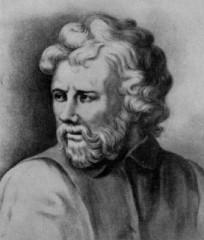
Epictetus
Epictetus

Epictetus was a renowned Greek philosopher born in 55 AD and died in 135 AD. He founded the Stoic school of philosophy, emphasizing the importance of reason, morality, and self-control, which had a profound impact on subsequent philosophy. more

You May Also Like

“It would be tedious to relate the Gradgrindian detail - economic, social and cultural (in the anthropological sense) - with which Scottish Screen implemented its industrial model during the thirteen years of its existence between 1997 and 2010. Collectively, the Scottish Screen website's policy guidelines and application forms for its innumerable schemes at every level of production and training constituted a manual for how to crush the life out of a creative project.”

“If I have so far argued that Foucault is a kind of closet liberal and thus deeply modern, I need to be equally critical of evangelical (and especially American) Christianity's modernity and its appropriation of Enlightenment notions of the autonomous self. Indeed, many otherwise orthodox Christians, who recoil at the notion of theological liberalism, have unwittingly adopted notions of freedom and autonomy that are liberal to the core. Averse to hierarchies and control, contemporary evangelicalism thrives on autonomy: the autonomy of the nondenominational church, at a macrocosmic level, and the autonomy of the individual Christian, at the microcosmic level. And it does not seem to me that the emerging church has changed much on this score; indeed, some elements of emergent spirituality are intensifications of this affirmation of autonomy and a laissez-faire attitude with respect to institutions.”

“This notion that we must wait and wait while we slowly progress out of enslavement into liberation, out of ignorance into knowledge, out of the present limitations into a future union with the Divine, is only true if we let it be so. But we need not. We can shift our identification from the ego to the Overself in our habitual thinking, in our daily reactions and attitudes, in our response to events and the world. We have thought our way into this unsatisfactory state; we can unthink our way out of it. By incessantly remembering what we really are, here and now at this very moment, we set ourselves free. Why wait for what already is?”

“This then is the ultimate truth--that in our inmost nature we are anchored in God, inseparable from God, and that the discovery of this heavenly nature is life's loftiest purpose. Even now, already, today, we are as divine as we ever shall be. The long evolutionary ladder which by prophets and teachers, gurus and guides we are bidden to climb toilsomely and slowly and painfully need not be climbed at all if only we heed this truth continually, if we refuse to let it go, if we make it ours in all parts of our being--in thought, feeling, faith, and action.”

“It would be wonderful if everyone, everywhere, could slip so easily into the kingdom of heaven, and just as easily stay there forever. But alas! the facts of human nature forbid it. People require teaching, training, purifying, disciplining, and preparing, before they can do so […] Purification of the heart and calming of the mind are necessary prerequisites for penetrating into the Overself […] The attempt to ignore order of development in the Quest, to leap from the lowest to the highest stages, to miss all the intervening ones, is an attempt to get something for nothing. It cannot succeed. For the influx of Spirit needs a chalice clean enough to be fit for it, large enough to hold it. What would happen if the influx were poured into a dirty, cracked, tiny, and weak vessel? […]  the mind, nerves, emotions, and body of the man shall be gradually made capable of sustaining the influx of the Solar Force, or Spirit-Energy.”