Quotessence
Home / Quotes / Quote by Hermann Hesse

Quote by Hermann Hesse

“And he had to say farewell to his hands, his eyes, to hunger and thirst, to love, to playing the lute, to sleeping and waking, to everything. Tomorrow a bird would fly through the air and Goldmund would no longer see it, a girl would sing in a window and he would not hear her song, the river would run and the dark fish would swim silently, the wind would blow and sweep the yellow leaves on the ground, the sun would shine and stars would blink in the sky, young men would go dancing, the first snow would lie on the distant mountains—everything would go on, trees would cast their shadows, people would look gay or sad out of their living eyes, dogs would bark, cows would low in the barns of villages, and all of it without Goldmund.”

Quote by Hermann Hesse

Work

Narcissus and Goldmund

Browse quotes and source details for this work. more

Author
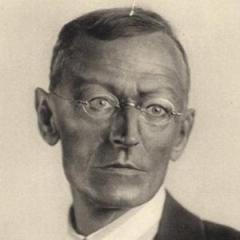
Hermann Hesse
Hermann Hesse

Hermann Hesse was a German poet and novelist, born on July 2, 1877, and died on August 9, 1962. Known for his profound psychological descriptions and exploration of human nature, his works include classics such as 'Steppenwolf' and 'The Glass Bead Game'. more

You May Also Like

“Something wonderful has happened to me. I was carried up into the seventh heaven. There all the gods sat assembled. By special grace I was granted the favor of a wish. "Will you," said Mercury, "have youth, or beauty, or power, or a long life, or the most beautiful maiden, or any of the other glories we have in the chest? Choose, but only one thing." For a moment I was at a loss. Then I addressed myself to the gods as follows: "Most honorable contemporaries, I choose this one thing, that I may always have the laugh on my side." Not one of the gods said a word, on the contrary, they all began to laugh. Hence, I concluded that my request was granted, and found that the gods knew how to express themselves with great taste; for it would hardly have been suitable for them to answer gravely: "It is granted thee".”

“Death is a strange thing. People live their whole lives as if it does not exist and yet it's often one of the great motivations for living. Some of us in time become so conscious of it that we live harder, more obstinately, with more fury. Some need its constant presence to even be aware of its antithesis. Others become so preoccupied with it that they go into the waiting room long before it has announced its arrival. We fear it, yet most of us fear more than anything that it may take someone other than ourselves. For the greatest fear of death is always that it will pass us by and leave us there alone.”

“I have lived in seventy-two cities over the course of my life," the old man said, proudly. "There is no part of the world, I know nothing about." The young people on the bench beside him looked at him with admiration. "And which city did you like best?" one asked him. The old man thought for a long time, then sighed. "Now I look back," he said, "I think I was happiest in the village in the country where I grew up. If it had been the second place I had lived, I think I should have stayed there my whole life. But because it was the first, I convinced myself that there must be somewhere better and have never stopped looking for it.”