Quotessence
Home / Quotes / Quote by Leo Tolstoy

Quote by Leo Tolstoy

“A little muzhik was working on the railroad, mumbling in his beard. And the candle by which she had read the book that was filled with fears, with deceptions, with anguish, and with evil, flared up with greater brightness than she had ever known, revealing to her all that before was in darkness, then flickered, grew faint, and went out forever.”

Quote by Leo Tolstoy

Work

ANNA KARENINA

Anna Karenina is a profound literary work that delves into the complexities of human relationships and the impact of societal expectations on individual lives. The story follows the tragic fate of Anna, a married woman who falls in love with Count Vronsky, leading to a series of dramatic events that challenge the moral and social fabric of her world. more

Author

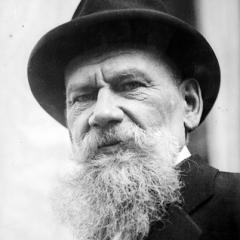
Leo Tolstoy
Leo Tolstoy

Leo Tolstoy was a Russian writer and thinker, a prominent representative of 19th-century Russian literature. His works deeply revealed social contradictions and human nature, and had a profound impact on the world. more

You May Also Like

“Lily appeared, wearing her nightclothes, in the doorway. She gave an impatient sigh. 'This is certainly a very LONG private conversation,' she said. 'And there are certain people waiting for their comfort object.' Lily,' her mother said fondly, 'you're very close to being an Eight, and when you're an Eight, your comfort object will be taken away. It will be recycled to the younger children. You should be starting to go off to sleep without it.' But her father had already gone to the shelf and taken down the stuffed elephant which was kept there. Many of the comfort objects, like Lily's, were soft, stuffed, imaginary creatures. Jonas's had been called a bear. Here you are, Lily-billy,' he said. 'I'll come help you remove your hair ribbons.”

“Feminism is the struggle to end sexist oppression. Therefore, it is necessarily a struggle to eradicate the ideology of domination that permeates Western culture on various levels, as well as a commitment to reorganizing society so that the self-development of people can take precedence over imperialism, economic expansion, and material desires.”

“Even an entire society, a nation, or all simultaneously existing societies taken together, are not the owners of the earth. They are simply its possessors, its beneficiaries, and have to bequeath it in an improved state to succeeding generations as boni patres familias [good heads of the household].”