Quotessence
Home / Quotes / Quote by Stefan Zweig

Quote by Stefan Zweig

Work

Beware of Pity

Browse quotes and source details for this work. more
Author

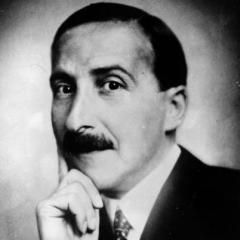
Stefan Zweig
Stefan Zweig

Stefan Zweig, born on November 28, 1881 in Vienna, was an Austrian novelist, playwright, and biographer. Known for his profound psychological insights and unique narrative style, he is a significant figure in European literature at the beginning of the 20th century. more

You May Also Like

“He had to have her, he definitely had to have her. She was not merely the latest object on which his greedy desire to be saved had fixed itself; no, she was the woman who was going to save him. The woman whose fine intelligence and deep sympathy and divine body, yes, whose divine body would successfully deflect his attention from the gloomy well shaft of his feelings and the contemplation of his past.”

“...The spiritual Oriental teachers say a person has three forms of mind,'' Beatrice was explaining to him once, while they were on break between one lesson and another at university, ''which are the dense mind, the subtle level and the ultra-subtle mind. Primary Consciousness, or the dense mind, is that existential, Sartrean mind which is related to our senses and so it is guided directly by human primitive instincts; in Sanskrit, this is referred to as ālaya-vijñāna which is directly tied to the brain. The subtle mind comes into effect when we begin to be aware of our true nature or that which in Sanskrit is called Ātman or self-existent essence that eventually leads us to the spiritual dimension. Ultimately there is the Consciousness-Only or the Vijñapti-Mātra, an ultra-subtle mind which goes beyond what the other two levels of mind can fabricate, precisely because this particular mind is not a by-product of the human brain but a part of the Cosmic Consciousness of the Absolute, known in Sanskrit as Tathāgatagarbha, and it is at this profound level of Consciousness that we are able to achieve access to the Divine Wisdom and become one with it in an Enlightened State.'' ''This spiritual subject really fascinates me,'' the Professor would declare, amazed at the extraordinary knowledge that Beatrice possessed.'' ''In other words, a human being recognises itself from its eternal essence and not from its existence,'' Beatrice replied, smiling, as she gently touched the tip of his nose with the tip of her finger, as if she was making a symbolic gesture like when children are corrected by their teachers. ''See, here,'' she had said once, pulling at the sleeve of his t-shirt to make him look at her book. ''For example, in the Preface to the 1960 Notes on Dhamma, the Buddhist philosopher from the University of Cambridge, Ñāṇavīra Thera, maintains those that have understood Buddhist teachings have gone way beyond Existential Thought. And on this same theme, the German scholar of Buddhist texts, Edward Conze, said that the possible similarity that exists between Buddhist and Existential Thought lies only on the preliminary level. He said that in terms of the Four Noble Truths, or in Sanskrit Catvāri Āryasatyāni, the Existentialists have only the first, which teaches everything is ill. Of the second - which assigns the origin of ill to craving - they have a very imperfect grasp. As for the third and fourth, which consist of letting go of craving, and the Noble Eightfold Path that leads to liberation from the cycle of rebirth in the form of Nirvāṇa - these are unheard of. Knowing no way out, the Existentialists are manufacturers of their own woes...”

“In 1989, I asked the GDR ambassador in Washington, D.C. why his country made such junky two-cylinder cars. He said the goal was to develop good public transportation and discourage the use of costly private vehicles. But when asked to choose between a rational, efficient, economically sound and ecologically sane mass transportation system or an automobile with its instant mobility, special status, privacy, and personal empowerment, the East Germans went for the latter, as do most people in the world. The ambassador added ruefully: "We thought building a good society would make good people. That's not always true." Whether or not it was a good society, at least he was belatedly recognizing the discrepancy between public ideology and private desire.”