Quotessence
Home / Quotes / Quote by Ralph Waldo Emerson

Quote by Ralph Waldo Emerson

Author

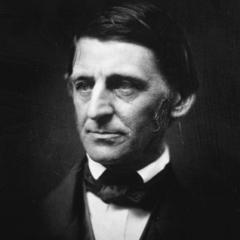
Ralph Waldo Emerson
Ralph Waldo Emerson

American essayist, poet, and philosopher. Born on May 25, 1803, and died on April 27, 1882. Known for his transcendentalist philosophy, his works have had a profound impact on literature and the intellectual world. more

You May Also Like

“She had memories of a quiet pool in the woods, where she'd retreat with her books, hiding from chores that needed to be done around the house. She remembered the sound of her parents after sunset, calling her to come home. The fireflies would flicker around her as it became too dark to read, but still she'd stay, to watch the fireflies over the water and listen to the birds and the squirrels settle in for the night and the night hunters, the owls and and the cats, begin to wake. Once, she'd even glimpsed a unicorn sipping from the pond, but it could have been only a white deer and a trick of the twilight. Another afternoon, her father had come with her, avoiding his chores too. They'd read books side by side, and her mother hadn't said a word when they'd returned. A week later, her mother had been the one to join her by the pond, arriving with lunch in a basket and presenting Kiela with a new unread book, a rare treasure on the island.”

“Parents build the foundation of our lives, and we go through our life feeling this is the way things are suppose to me. For the most part there’s positives surrounding us, so we never take the time to think about the sacrifices our parents have made to get us on our feet. Once their gone, heaven awaits, and their together. We wonder in complete reflection how they accomplished so much! We look back grateful and, fulfilled. I’m one of four siblings, and us four are mom, and dads’ greatest achievements. Thank you, Mom and Dad, and thank you Jesus. Amen.”

“Complex structural dissociation involves an extensive range of phobias that exacerbate and maintain dissociation and impede functional adaptation. They include the phobia of (1) mental actions (i.e., an individual's inner experience of emotions, thoughts body sensations, needs, wishes); (2) dissociative parts of the personality; (3) attachment and attachment loss; (4) traumatic memory; and (5) change and healthy risk taking (van der Hart et al., 2006).”

“Based on theoretical analysis, clinical observations, and some research findings (e.g., Kluft & Fine, 1993; Nijenhuis, Van der Hart, & Steele, 2002; Putnam, 1997; Reinders et al., 2003, submitted; Steinberg, 1995), as well as on 19th and early 20th century literature on dissociation (cf., Van der Hart & Dorahy, in press), we propose that traumatization essentially involves a degree of dissociative division of the personality that likely occurs along the lines of innate action systems of daily life and defense— what has been called structural dissociation of the personality (e.g., Nijenhuis et al., 2002; Van der Hart, Nijenhuis, Steele, & Brown, 2004). Dissociation of the personality develops when children or adults are exposed to potentially traumatizing events, and when their integrative capacity is insufficient to (fully) integrate these experiences within the confines of a relatively coherent personality.”

“Sometimes a stare comes from too much anxiety or stress. Your system can become overwhelmed." I didn't know it then. but parts inside were scared because he was looking at us so closely. He's getting too close. He's going to find out about us. I didn't make the effort to try to catch any of these thoughts.”

“I still didn't know very much about the complex coping mechanism that had helped me survive my childhood. It was as if my conscious mind wasn't strong enough yet to fully grasp that I had parts. I knew it superficially, but I didn't feel it all the way through.”

“State integration involves linkage in at least three different dimensions of our lives. The first level of integration is between our different states—the “inter” dimension. We must accept our multiplicity, the fact that we can show up quite differently in our athletic, intellectual, sexual, spiritual—or many other—states. A heterogeneous collection of states is completely normal in us humans. The key to well-being is collaboration across states, not some rigidly homogeneous unity. The notion that we can have a single, totally consistent way of being is both idealistic and unhealthy.”