Quotessence
Home / Quotes / Quote by Martha Graham

Quote by Martha Graham

“...a dancer dies twice—once when they stop dancing, and this first death is the more painful.”

Quote by Martha Graham

Author
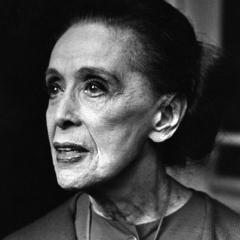
Martha Graham
Martha Graham

Martha Graham, born on May 11, 1894, and died on April 1, 1991, was one of the pioneers of modern dance in the United States. Known as the 'Mother of Modern Dance', she was renowned for her unique dance style and profound emotional expression. more

You May Also Like

“In her fantastic mood she stretched her soft, clasped hands upward toward the moon. 'Sweet moon,' she said in a kind of mock prayer, 'make your white light come down in music into my dancing-room here, and I will dance most deliciously for you to see". She flung her head backward and let her hands fall; her eyes were half closed, and her mouth was a kissing mouth. 'Ah! sweet moon,' she whispered, 'do this for me, and I will be your slave; I will be what you will.' Quite suddenly the air was filled with the sound of a grand invisible orchestra. Viola did not stop to wonder. To the music of a slow saraband she swayed and postured. In the music there was the regular beat of small drums and a perpetual drone. The air seemed to be filled with the perfume of some bitter spice. Viola could fancy almost that she saw a smoldering campfire and heard far off the roar of some desolate wild beast. She let her long hair fall, raising the heavy strands of it in either hand as she moved slowly to the laden music. Slowly her body swayed with drowsy grace, slowly her satin shoes slid over the silver sand. The music ceased with a clash of cymbals. Viola rubbed her eyes. She fastened her hair up carefully again. Suddenly she looked up, almost imperiously. "Music! more music!" she cried. Once more the music came. This time it was a dance of caprice, pelting along over the violin-strings, leaping, laughing, wanton. Again an illusion seemed to cross her eyes. An old king was watching her, a king with the sordid history of the exhaustion of pleasure written on his flaccid face. A hook-nosed courtier by his side settled the ruffles at his wrists and mumbled, 'Ravissant! Quel malheur que la vieillesse!' It was a strange illusion. Faster and faster she sped to the music, stepping, spinning, pirouetting; the dance was light as thistle-down, fierce as fire, smooth as a rapid stream. The moment that the music ceased Viola became horribly afraid. She turned and fled away from the moonlit space, through the trees, down the dark alleys of the maze, not heeding in the least which turn she took, and yet she found herself soon at the outside iron gate. ("The Moon Slave")”

“As the sun began to rise, the man reached out to the woman, and they clasped hands. He cradled her, and languidly they lifted themselves up to their feet, their bodies brushing, their eyes lost in each other's. Sensuously, deliberately, they danced, moving as though they were one, their body language smooth as their limbs carefully unfolded. They twirled and rocked, intertwined and separated, nearly leaning onto one another but barely touching, their movements sometimes tender, sometimes almost violent...Moments passed while the dancers held tight to each other, as though their bodies were melting together. The expression on their features as they lifted their faces to the sky was one of unimaginable joy.”