Quotessence
Home / Quotes / Quote by Agatha Christie

Quote by Agatha Christie

“Me and my old man went on a coach trip to Switzerland and Italy once and it was a whole hour further on there. Must be something to do with this Common Market. I don't hold with the Common Market and nor does Mr. Curtain. England's good enough for me.”

Quote by Agatha Christie

Work

The Clocks

Browse quotes and source details for this work. more

Author

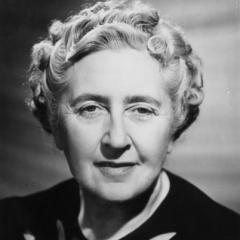
Agatha Christie
Agatha Christie

Agatha Christie, a renowned British detective novel writer, is known as the Queen of Detective Fiction. She was born on September 15, 1890, and passed away on January 12, 1976. Christie's works are characterized by intricate plots, unique reasoning, and vivid characters, and have had a profound impact on detective fiction worldwide. more

You May Also Like

“The street that ran down from the poorhouse into the metropolis was chock-full of destinies. In that street there were many thousands of heads, which appeared in the window frames every morning, young heads and old ones, blond ones and brunette ones; and in each of these heads something was happening... and so nobody was very much surprised when every now and then one of these people went and emptied his bucket of water on to the head of one of the others, threw down his pickaxe, pocketed his pay packet and vanished; when one fine day he resurfaced with his body sun-brazened and battered beyond belief, with wildly unkempt hair and a mind sorely unhinged by the world, and with thousands and thousands of worthy thoughts that he could never give vent to, because he was despised—and he walked, onwards and onwards—and finally jumped into some sewer somewhere amid the gray rows of houses, so that nobody could ever discover a trace of him again, apart perhaps from a waterlogged shoe, a shirt, some paper on which he had written what he was called, what was depressing him, and what, in his heart of hearts, he actually was…”

“Liao writes with the courage of a man who knows loss and doesn't fear it. There is nothing to make him notice like an official injunction against noticing, nothing to make him listen like official deafness, nothing that drives him to make us see like the blindness that officialdom seeks to impose.”

“As simple as that sounds, it is nevertheless extremely difficult to adequately discuss no-boundary awareness or nondual consciousness. This is because our language — the medium in which all verbal discussion must float — is a language of boundaries. As we have seen, words and symbols and thoughts themselves are actually nothing but boundaries, for whenever you think or use a word or name, you are already creating boundaries. Even to say "reality is no-boundary awareness" is still to create a distinction between boundaries and no-boundary! So we have to keep in mind the great difficulty involved with dualistic language. That "reality is no-boundary" is true enough, provided we remember that no-boundary awareness is a direct, immediate, and nonverbal awareness, and not a mere philosophical theory. It is for these reasons that the mystic-sages stress that reality lies beyond names and forms, words and thoughts, divisions and boundaries. Beyond all boundaries lies the real world of Suchness, the Void, the Dharmakaya, Tao, Brahman, the Godhead. And in the world of suchness, there is neither good nor bad, saint nor sinner, birth nor death, for in the world of suchness there are no boundaries.”

“Although one of the points of an Integral approach to any problem is to language that issue in a s large a number of levels as possible (Magic, Mythic, Rational, Pluralistic, Integral, and Super-Integral—and this includes the “conveyor belt” of spirituality), this doesn’t mean to cavalierly overlook Integral itself. The Integral level is a prerequisite for “Integral We” practices (although anybody can be invited to those practices; but realize that an “Integral” depth of the “We” will not be achieved in any group the majority of whose individuals are not themselves at Integral).”