Quotessence
Home / Quotes / Quote by Joseph Stalin

Quote by Joseph Stalin

“But having developed productive forces to a tremendous extent, capitalism has become enmeshed in contradictions which it is unable to solve. By producing larger and larger quantities of commodities, and reducing their prices, capitalism intensifies competition, ruins the mass of small and medium private owners, converts them into proletarians and reduces their purchasing power, with the result that it becomes impossible to dispose of the commodities produced. On the other hand, by expanding production and concentrating millions of workers in huge mills and factories, capitalism lends the process of production a social character and thus undermines its own foundation, inasmuch as the social character of the process of production demands the social ownership of the means of production; yet the means of production remain private capitalist property, which is incompatible with the social character of the process of production. These irreconcilable contradictions between the character of the productive forces and the relations of production make themselves felt in periodical crises of overproduction, when the capitalists, finding no effective demand for their goods owing to the ruin of the mass of the population which they themselves have brought about, are compelled to burn products, destroy manufactured goods, suspend production, and destroy productive forces at a time when millions of people are forced to suffer unemployment and starvation, not because there are not enough goods, but because there is an overproduction of goods.”

Quote by Joseph Stalin

Work

Dialectical and Historical Materialism

Browse quotes and source details for this work. more

Author
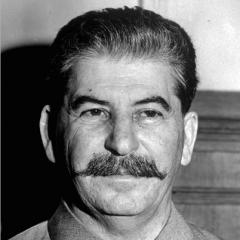
Joseph Stalin
Joseph Stalin

Joseph Stalin, the former Premier of the Soviet Union, was born on December 18, 1878, and died on March 5, 1953. He was the leader of the Soviet Communist Party and had a profound impact on the political, economic, and military development of the Soviet Union. more

You May Also Like

“The core fuel for your life should not come from your darkest places or past tormentors. It should not come from the foundation of pain from your past.”

“The specific economic form, in which unpaid surplus-labour is pumped out of direct producers, determines the relationship of rulers and ruled, as it grows directly out of production itself and, in turn, reacts upon it as a determining element. Upon this, however, is founded the entire formation of the economic community which grows up out of the production relations themselves, thereby simultaneously its specific political form. It is always the direct relationship of the owners of the conditions of production to the direct producers — a relation always naturally corresponding to a definite stage in the development of the methods of labour and thereby its social productivity — which reveals the innermost secret, the hidden basis of the entire social structure and with it the political form of the relation of sovereignty and dependence, in short, the corresponding specific form of the state. This does not prevent the same economic basis — the same from the standpoint of its main conditions — due to innumerable different empirical circumstances, natural environment, racial relations, external historical influences, etc. from showing infinite variations and gradations in appearance, which can be ascertained only by analysis of the empirically given circumstances.”

“The class struggle, which is always present to a historian influenced by Marx, is a fight for the crude and material things without which no refined and spiritual things could exist. Nevertheless, it is not in the form of the spoils which fall to the victor that the latter make their presence felt in the class struggle. They manifest themselves in this struggle as courage, humor, cunning, and fortitude. They have retroactive force and will constantly call in question every victory, past and present, of the rulers. As flowers turn toward the sun, by dint of a secret heliotropism the past strives to turn toward that sun which is rising in the sky of history. A historical materialist must be aware of this most inconspicuous of all transformations.”

“In studying such transformations it is always necessary to distinguish between the material transformation of the economic conditions of production, which can be determined with the precision of natural science, and the legal, political, religious, artistic or philosophic – in short, ideological forms in which men become conscious of this conflict and fight it out. Just as one does not judge an individual by what he thinks about himself, so one cannot judge such a period of transformation by its consciousness, but, on the contrary, this consciousness must be explained from the contradictions of material life, from the conflict existing between the social forces of production and the relations of production. No social order is ever destroyed before all the productive forces for which it is sufficient have been developed, and new superior relations of production never replace older ones before the material conditions for their existence have matured within the framework of the old society.”

“The uninterrupted victory of democracy, which to our revisionism as well as to bourgeois liberalism, appears as a great fundamental law of human history and, especially, modern history has shown upon closer examination to be a phantom. No absolute and general relation can be constructed between capitalist development and democracy. The political form of a given country is always the result of the composite of all the existing political factors, domestic as well as foreign. It admits within its limits all variations of the scale from absolute monarchy to the democratic republic.”

“At the present time, it is of course still impossible to foresee to any precise degree just what sections of the field of history will be illuminated and just how much light will be cast by a materialist investigation which would proceed from a more concrete study of the capitalist curve and the interrelationship between the latter and all the aspects of social life. Conquests that may be attained on this road can be determined only as the result of such an investigation itself, which must be more systematic, more orderly than those historical materialist excursions hitherto undertaken. In any case, such an approach to modern history promises to enrich the theory of historical materialism with conquests far more precious than the extremely dubious speculative juggling with the concepts and terms of the materialist method that has, under the pens of some of our Marxists, transplanted the methods of formalism into the domain of the materialist dialectic, and has led to reducing the task to rendering definitions and classifications more precise and to splitting empty abstractions into four equally empty parts; it has, in short, adulterated Marxism by means of the indecently elegant mannerisms of Kantian epigones. It is a silly thing indeed endlessly to sharpen and resharpen an instrument to chip away Marxist steel, when the task is to apply the instrument in working over the raw material!”