Quotessence
Home / Quotes / Quote by Socrates

Quote by Socrates

“Do we say that one must never willingly do wrong, or does it depend upon the circumstances? Is it true, as we have often agreed before, that there is no sense in which wrongdoing is good or honourable? Or have we jettisoned all our former convictions in these last few days? Can you and I at our age, Crito, have spent all these years in serious discussions without realizing that we were no better than a pair of children? Surely the truth is just what we have always said. Whatever the popular view is, and whether the alternative in pleasanter than the present one or even harder to bear, the fact remains that to do wrong is in every sense bad and dishonourable for the person who does it.”

Quote by Socrates

Work

Apology, Crito And Phaedo Of Socrates.

Browse quotes and source details for this work. more

Author
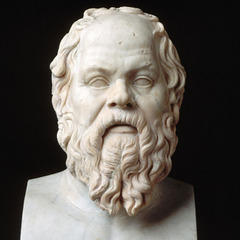
Socrates
Socrates

Socrates, a renowned Greek philosopher, lived from 471 BC to 399 BC. He is known for his unique teaching method, the Socratic method, which emphasizes self-discovery through questioning. Socrates' philosophical ideas have had a profound impact on subsequent philosophy, and he is considered one of the founders of Western philosophy. more

You May Also Like

“The truth of the profane was the falsehood of the Neophyte, and the truth of the Neophyte was the falsehood of the Zelator! Again and again the fortress must be battered down! Again and again the pylon must be overthrown! Again and again must the gods be desecrated!”

“But Jesus makes his appearance here only as a corpse; the living man, the wine-guzzling vagrant and precocious socialist, is never once mentioned, nor anything he ever had to say. Christ crucified rules, and it may be that the true business of modern Christianity is to crucify him again and again so that he can never get a word out of his mouth.”

“However, ana al-haqq as it stands has raised a few literary questions as well and, within the tradition of mystic poetry, the attitude preserved in Hallaj's expression has given rise to mixed reactions regarding its content. It is held that it is an exaggeration of subjective experience, and ana—the personal "I"—shows leanings toward megalomania and egotism. It is the personal "I" which overshadows al-haqq, and thereby invites total attention to itself. In fact, the personal "I" absorbs al-haqq, and reaches out to the romantic cult of the egostistical sublime. In this context, the truth tends to become subjective and, therefore, relative, and in its social implications it shows the possibility of numerous diversions. Extreme individualism, in contrast to institutionalism, is also held to be related to ana al-haqq. The personal "I" is supposed to be potentionally explosive and destructive for values of the Establishment. A.J. Arberry has summed up the position by saying that Hallaj had dared to declare that his direct awareness of God was for him a clearer proof than both revelation and reason.”

“How can you say one thing when your data shows something else. One doesn't know what was on the authors' minds and maybe they interpreted things differently but the sense is that the literature maintains an attitude somewhat like the approach of lawyers. If the jury buys it, it doesn't matter whether or not it's true. In scientific publishing, the jury are the reviewers and the editors. If they are already convinced of the conclusion, if there is no voir dire, you will surely win the case.”

“When demanded of those without power-- 'if you said it more nicely maybe we would listen'-- 'I can't hear you when you're so angry'-- 'the ones who are nice are the ones who will get what they want' (or, worse, the ones who are nice and pretty, which, of course, also includes white, Christian, and 'classy')-- it is yet another subjugation, yet another tool of oppression.”