Quotessence
Home / Quotes / Quote by Ernesto Sabato

Quote by Ernesto Sabato

“Fíjate que nunca he podido acabar una novela rusa. Son tan trabajosas… Aparecen millares de tipos y al final resulta que no son más que cuatro o cinco. Pero claro, cuando te empiezas a orientar con un señor que se llama Alexandre, luego resulta que se llama Sacha y luego Sachka y luego Sachenka, y de pronto algo grandioso como Alexandre Alexandrovitch Bunine y más tarde es simplemente Alexandre Alexandrovitch. Apenas te has orientado, ya te despistan nuevamente. Es cosa de no acabar: cada personaje parece una familia. No me vas a decir que no es agotador, mismo para ti.”

Quote by Ernesto Sabato

Work

El Túnel

Browse quotes and source details for this work. more

Author

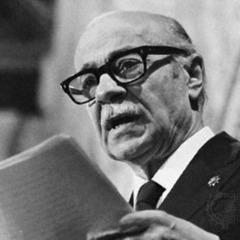
Ernesto Sabato
Ernesto Sabato

Argentinian writer, born on June 24, 1911, and died on April 30, 2011. Ernesto Sabato is known for his profound philosophical thoughts and unique literary style, being an important figure in Latin American literature of the 20th century. more

You May Also Like

“Disgusting foods, as Madame de Pompadour discovered, do not arouse the senses. They only dull them. Seduction, as you know by now, for women starts with the ears and for men starts with the eyes and for both, travels directly to the stomach. Some say you need sweet murmurings in the ears, but I say laughter, intrigue and delicacies are more powerful.”

“Death is only ever that free future we dream of when we put off everything and consign all things to their future occurrence. Objectively, the world is an illusion: it can only appear to us. Subjectively, it is the opposite: we regard it spontaneously as real. But one may propose the opposite: subjectively, the world is an illusion of our senses. Objectively, it has force of reality. Asymptote, clinamen, parallax, metalepsis - these are dance patterns, this is a whole non-linear geometry of theoretical space. Patterns of near-contact and reversal, of approaching the truth without ever succumbing to it.”

“The law itself was originally created in order to protect property. However, the law has been falsely attributed to being the reason property exists in the first place. At least, this is what the state would have us believe. The law does not create property rights because these already existed before the law was created. It is this false attribution that allows the state apparatus to conduct its mission of expropriation.”

“In England, in the Netherlands, in France, from the sixteenth century on, economic and political violence expropriated craftsmen and peasants, repressed indigence and vagrancy, imposed wage-labor on the poor. Between 1930 and 1950, Russia decreed a labor code which included capital punishment in order to organise the transition of millions of peasants to industrial wage-labor in less than a few decades. Seemingly normal facts: that an individual has nothing but his labor power, that he must sell it to a business unit to be able to live, that everything is a commodity, that social relations revolve around market exchange ... such facts now taken for granted result from a long, brutal process.”