Quotessence
Home / Authors / Aristotle Books
Aristotle

Aristotle Books

Philosopher

Economics

A source page for quotes linked to Aristotle.
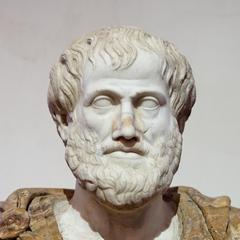
0 quotes

Ethics

A source page for quotes linked to Aristotle.

0 quotes

Problems ...

A source page for quotes linked to Aristotle.

0 quotes

The poetics

A source page for quotes linked to Aristotle.

0 quotes

Related Quotes

“For moral excellence is concerned with pleasures and pains; it is on account of pleasure that we do bad things, and on account of pain that we abstain from noble ones. Hence we ought to have been brought up in a particular way from our very youth, as Plato says, so as both to delight in and to be pained by the things that we ought; for this is the right education.”

“There are crimes of which the motive is want; and for these Phaleas expects to find a cure in the equalization of property, which will take away from a man the temptation to be a highwayman, because he is hungry or cold. But want is not the sole incentive to crime; men also wish to enjoy themselves and not to be in a state of desire- they wish to cure some desire, going beyond the necessities of life, which preys upon them; nay, this is not the only reason- they may desire superfluities in order to enjoy pleasures unaccompanied with pain, and therefore they commit crimes.”

“The most hated sort, and with the greatest reason, is usury, which makes a gain out of money itself, and not from the natural object of it. For money was intended to be used in exchange, but not to increase at interest. And this term interest, which means the birth of money from money, is applied to the breeding of money because the offspring resembles the parent. Wherefore of all modes of getting wealth this is the most unnatural.”

“Equity bids us be merciful to the weakness of human nature; to think less about the laws than about the man who framed them, and less about what he said than about what he meant; not to consider the actions of the accused so much as his intentions; nor this or that detail so much as the whole story; to ask not what a man is now but what he has always or usually been.”

“Again, a beautiful object, whether it be a living organism or any whole composed of parts, must not only have an orderly arrangement of parts, but must also be of a certain magnitude; for beauty depends on magnitude and order. Hence a very small animal organism cannot be beautiful; for the view of it is confused, the object being seen in an almost imperceptible moment of time. Nor, again, can one of vast size be beautiful; for as the eye cannot take it all in at once, the unity and sense of the whole is lost for the spectator; as for instance if there were one a thousand miles long. As, therefore, in the case of animate bodies and organisms a certain magnitude is necessary, and a magnitude which may be easily embraced in one view; so in the plot, a certain length is necessary, and a length which can be easily embraced by the memory. The limit of length in relation to dramatic competition and sensuous presentment, is no part of artistic theory. For had it been the rule for a hundred tragedies to compete together, the performance would have been regulated by the water-clock,--as indeed we are told was formerly done. But the limit as fixed by the nature of the drama itself is this: the greater the length, the more beautiful will the piece be by reason of its size, provided that the whole be perspicuous. And to define the matter roughly, we may say that the proper magnitude is comprised within such limits, that the sequence of events, according to the law of probability or necessity, will admit of a change from bad fortune to good, or from good fortune to bad.”

“It is a great thing, indeed, to make a proper use of the poetical forms, as also of compounds and strange words. But the greatest thing by far is to be a master of metaphor. It is the one thing that cannot be learnt from others; and it is also a sign of genius, since a good metaphor implies an intuitive perception of the similarity in dissimilars.”

“All men by nature desire to know. An indication of this is the delight we take in our senses; for even apart from their usefulness they are loved for themselves; and above all others the sense of sight. For not only with a view to action, but even when we are not going to do anything, we prefer seeing (one might say) to everything else. The reason is that this, most of all the senses, makes us know and brings to light many differences between things.”

“Happiness, therefore, does not lie in amusement; it would, indeed, be strange if the end were amusement, and one were to take trouble and suffer hardship all one's life in order to amuse oneself. For, in a word, everything that we choose we choose for the sake of something else, except happiness, which is an end. Now to exert oneself and work for the sake of amusement seems silly and utterly childish. But to amuse oneself in order that one may exert oneself, as Anacharsis puts it, seems right; for amusement is a sort of relaxation, and we need relaxation because we cannot work continuously. Relaxation, then, is not an end; for it is taken for the sake of activity.”

“Hence a young man is not a proper hearer of lectures on political science; for he is inexperienced in the actions that occur in life, but its discussions start from these and are about these; and, further, since he tends to follow his passions, his study will be vain and unprofitable, because the end aimed at is not knowledge but action. And it makes no difference whether he is young in years or youthful in character; the defect does not depend on time, but on his living, and pursuing each successive object, as passion directs. For to such persons, as to the incontinent, knowledge brings no profit; but to those who desire and act in accordance with a rational principle knowledge about such matters will be of great benefit.”

“Wherefore we ought not childishly to neglect the study even of the most despised animals, for in all natural objects there lies something marvelous. And as it is related of Heraclitus that certain strangers who came to visit him, when, they found him warming himself at the kitchen fire, stopped short he bade them enter without fear, for there also were the gods: so we ought to enter without false shame on the examination of all living beings, for in all of them resides something of nature and beauty.”