Quotessence
Home / Authors / D. H. Lawrence
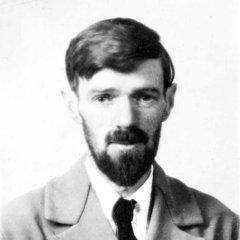
D. H. Lawrence

D. H. Lawrence Quotes

Novelist

Filter quotes by topic

Famous D. H. Lawrence Quotes

“Paris was sad. One of the saddest towns: weary of its now-mechanical sensuality, weary of the tension of money, money, money, weary even of resentment and conceit, just weary to death, and still not sufficiently Americanized or Londonized to hide the weariness under a mechanical jig-jig-jig!”

“And still I look for the men who will dare to be roses of England wild roses of England men who are wild roses of England with metal thorns, beware! but still more brave and still more rare the courage of rosiness in a cabbage world fragrance of roses in a stale stink of lies rose-leaves to bewilder the clever fools and rose-briars to strangle the machine.”

“There is a brief time for sex, and a long time when sex is out of place. But when it is out of place as an activity there still should be the large and quiet space in the consciousness where it lives quiescent. Old people can have a lovely quiescent sort of sex, like apples, leaving the young quite free for their sort.”

“What sex is, we don't know, but it must be some sort of fire. For it always communicates a sense of warmth, of glow. And when this glow becomes a pure shine, then we feel the sense of beauty. We all have the fire of sex slumbering or burning inside us. If we live to be ninety, it is still there. Or, if it dies, we become one of those ghastly living corpses which are unfortunately becoming more numerous in the world.”

“Be still when you have nothing to say; when genuine passion moves you, say what you've got to say, and say it hot.”

“Things men have made with wakened hands, and put soft life into are awake through years with transferred touch, and go on glowing for long years. And for this reason, some old things are lovely warm still with the life of forgotten men who made them.”

“It was not the passion that was new to her, it was the yearning adoration. She knew she had always feared it, for it left her helpless; she feared it still, lest if se adored him too much, then she would lose herself, become effaced, and she did not want to be effaced, a slave, like a savage woman. She must not become a slave. She feared her adoration, yet she would not at once fight against it.”

“Was his life nothing? Had he nothing to show, no work? He did not count his work, anyone could have done it. What had he known, but the long, marital embrace with his wife. Curious, that this was what his life amounted to! At any rate, it was something, it was eternal. He would say so to anybody, and be proud of it. He lay with his wife in his arms, and she was still his fulfillment, just the same as ever. And that was the be-all and the end-all. Yes, and he was proud of it.”

“Why, oh why must one grow up, why must one inherit this heavy, numbing responsibility of living an undiscovered life? Out of the nothingness and the undifferentiated mass, to make something of herself! But what? In the obscurity and pathlessness to take a direction! But whither? How take even one step? And yet, how stand still? This was torment indeed, to inherit the responsibility of one’s own life.”

“Brute force crushes many plants. Yet the plants rise again. The Pyramids will not last a moment compared with the daisy. And before Buddha or Jesus spoke the nightingale sang, and long after the words of Jesus and Buddha are gone into oblivion the nightingale still will sing. Because it is neither preaching nor commanding nor urging. It is just singing. And in the beginning it was not a Word, but a chirrup.”

“The cosmos is a vast living body, of which we are still parts. The sun is a great heart whose tremors run through our smallest veins. The moon is a great nerve center from which we quiver forever. Who knows the power that Saturn has over us, or Venus? But it is a vital power, rippling exquisitely through us all the time.”

“I like relativity and quantum theories because I don't understand them and they make me feel as if space shifted about like a swan that can't settle, refusing to sit still and be measured; and as if the atom were an impulsive thing always changing its mind.”