Quotessence
Home / Authors / Francis Parkman Books
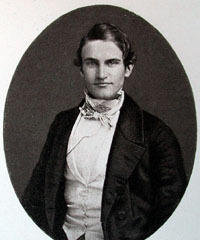
Francis Parkman

Francis Parkman Books

Historian

Related Quotes

“The Spanish voyager, as his caravel ploughed the adjacent seas, might give full scope to his imagination, and dream that beyond the long, low margin of forest which bounded his horizon lay hid a rich harvest for some future conqueror; perhaps a second Mexico with its royal palace and sacred pyramids, or another Cuzco with its temple of the Sun, encircled with a frieze of gold. Haunted by such visions, the ocean chivalry of Spain could not long stand idle.”

“If any pale student, glued to his desk, here seek an apology for a way of life whose natural fruits is that pallid and emasculate scholarship of which New England has had too many examples, it will be far better that this sketch had not been written. For the student there is, in its season, no better place than the saddle, and no better companion than the rifle or the oar.”

“The growth of New England was a result of the aggregate efforts of a busy multitude, each in his narrow circle toiling for himself, to gather competence or wealth. The expansion of New France was the achievement of a gigantic ambition striving to grasp a continent. It was a vain attempt.”

“In the middle of the sixteenth century, Spain was the incubus of Europe. Gloomy and portentous, she chilled the world with her baneful shadow.”

“America was still a land of wonder. The ancient spell still hung unbroken over the wild, vast world of mystery beyond the sea,-a land of romance, adventure, and gold.”

“The young nobles, of whom there were many, were volunteers, who had paid their own expenses in expectation of a golden harvest, and they chafed in impatience and disgust. The religious element in the colony-unlike the former Huguenot emigration to Brazil--was evidently subordinate. The adventurers thought more of their fortunes than of their faith.”

“The monk, the inquisitor, and the Jesuit were lords of Spain,- sovereigns of her sovereign, for they had formed the dark and narrow mind of that tyrannical recluse. They had formed the minds of her people, quenched in blood every spark of rising heresy, and given over a noble nation to a bigotry blind and inexorable as the doom of fate. Linked with pride, ambition, avarice, every passion of a rich, strong nature, potent for good and ill, it made the Spaniard of that day a scourge as dire as ever fell on man.”

“When America was first made known to Europe, the part assumed by France on the borders of that new world was peculiar, and is little recognized. While the Spaniard roamed sea and land, burning for achievement, red-hot with bigotry and avarice, and while England, with soberer steps and a less dazzling result, followed in the path of discovery and gold-hunting, it was from France that those barbarous shores first learned to serve the ends of peaceful commercial industry.”

“In one point the plan was fatally defective, since it involved the deadly enmity of a race whose character and whose power were as yet but ill understood,--the fiercest, boldest, most politic, and most ambitious savages to whom the American forest has ever given birth.”

“Faithfulness to the truth of history involves far more than a research, however patient and scrupulous, into special facts. Such facts may be detailed with the most minute exactness, and yet the narrative, taken as a whole, may be unmeaning or untrue. The narrator must seek to imbue himself with the life and spirit of the time. He must study events in their bearings near and remote; in the character, habits, and manners of those who took part in them. He must himself be, as it were, a sharer or a spectator of the action he describes.”

“Many of the Iroquois and Huron houses were of similar construction, the partitions being at the sides only, leaving a wide passage down the middle of the house.”