Quotessence
Home / Authors / Friedrich Nietzsche
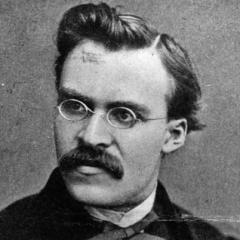
Friedrich Nietzsche

Friedrich Nietzsche Quotes

Philologist

Filter quotes by topic

Famous Friedrich Nietzsche Quotes

“The free spirit again draws near to life - slowly, to be sure, almost reluctantly, almost mistrustfully. It again grows warmer about him, yellower as it were; feeling and feeling for others acquire depth, warm breezes of all kind blow across him. It seems to him as if his eyes are only now open to what is close at hand. he is astonished and sits silent: where had he been? These close and closest things: how changed they seem! what bloom and magic they have acquired! He looks back gratefully - grateful to his wandering, to his hardness and self-alienation, to his viewing of far distances and bird-like flights in cold heights. What a good thing he had not always stayed "at home," stayed "under his own roof" like a delicate apathetic loafer! He had been -beside himself-: no doubt about that. Only now does he see himself - and what surprises he experiences as he does so! What unprecedented shudders! What happiness even in the weariness, the old sickness, the relapses of the convalescent! How he loves to sit sadly still, to spin out patience, to lie in the sun! Who understands as he does the joy that comes in winter, the spots of sunlight on the wall! They are the most grateful animals in the world, also the most modest, these convalescents and lizards again half-turned towards life: - there are some among them who allow no day to pass without hanging a little song of praise on the hem of its departing robe. And to speak seriously: to become sick in the manner of these free spirits, to remain sick for a long time and then, slowly, slowly, to become healthy, by which I mean "healthier," is a fundamental cure for all pessimism.”

“He who seeks may go astray. All solitude is sin/ says the herd. And long were you yourself of the herd. The voice of the herd still lingers in you, and when you shall say: ‘I no longer have a common conscience with them’, it shall be a grief and pain to you. You call yourself free? I would hear of your master-thought, not of your escape from the yoke. Are you a man that should escape from the yoke? Many have cast off all their values when they cast off their servitude. Free from what? How does that concern Zarathustra? Let your eye answer me frankly: Free for what? ... a day will come when loneliness shall weary you, when your pride shall writhe and your courage gnash its teeth. In that day you shall cry: I am alone. A day will come when you shall see your high things no more, and your low things all too near; you shall fear your exaltation as if it were a phantom. In that day you will cry: All is false. There are emotions that seek to slay the solitary; if they don’t succeed they must perish themselves. Are you able to be a murderer?”

“It is the business of the very few to be independent; it is a privilege of the strong. And whoever attempts it, even with the best right, but without being OBLIGED to do so, proves that he is probably not only strong, but also daring beyond measure. He enters into a labyrinth, he multiplies a thousandfold the dangers which life in itself already brings with it; not the least of which is that no one can see how and where he loses his way, becomes isolated, and is torn piecemeal by some minotaur of conscience. Supposing such a one comes to grief, it is so far from the comprehension of men that they neither feel it, nor sympathize with it. And he cannot any longer go back! He cannot even go back again to the sympathy of men!”

“Be not virtuous beyond your powers! And seek nothing from yourselves opposed to probability!... Shy, ashamed, awkward, like the tiger whose spring hath failed—thus, ye higher men, have I often seen you slink aside. A cast which ye made had failed... The higher its type, always the seldomer doth a thing succeed. Ye higher men here, have ye not all—been failures? Be of good cheer; what doth it matter? How much is still possible! Learn to laugh at yourselves, as ye ought to laugh! What wonder even that ye have failed and only half-succeeded, ye half-shattered ones! Doth not—man's future strive and struggle in you? Man's furthest, profoundest, star-highest issues, his prodigious powers—do not all these foam through one another in your vessel? What wonder that many a vessel shattereth! Learn to laugh at yourselves, as ye ought to laugh! Ye higher men, Oh, how much is still possible!”

“One not only wants to be understood when one writes, but also quite as certainly not to be understood. It is by no means an objection to a book when someone finds it unintelligible: perhaps this might just have been the intention of its author, perhaps he did not want to be understood by "anyone”. A distinguished intellect and taste, when it wants to communicate its thoughts, always selects its hearers; by selecting them, it at the same time closes its barriers against "the others". It is there that all the more refined laws of style have their origin: they at the same time keep off, they create distance, they prevent "access" (intelligibility, as we have said,) while they open the ears of those who are acoustically related to them.”

“But how can we venture to reprove or praise the universe! Let us beware of attributing to it heartlessness and unreason or their opposites: it is neither perfect nor beautiful nor noble, and has no desire to become any of these; it is by no means striving to imitate mankind! It is quite impervious to all our aesthetic and moral judgments! It has likewise no impulse to self-preservation or impulses of any kind; neither does it know any laws. Let us beware of saying there are laws in nature. There are only necessities: there is no one to command, no one to obey, no one to transgress...”

“Et garde-toi des bons et des justes ! Ils aiment à crucifier ceux qui s’inventent leur propre vertu, — ils haïssent le solitaire. Garde-toi aussi de la sainte innocence ! Tout ce qui n'est pas simple lui est impie ; elle aime aussi à jouer avec le feu... des bûchers. Et garde-toi des accès de ton amour ! Trop vite le solitaire tend la main à celui qu’il rencontre. Il y a des hommes à qui tu ne dois pas donner la main, mais seulement la patte : et je veux que ta patte ait aussi des griffes. Mais le plus dangereux ennemi que tu puisses rencontrer sera toujours toi-même ; c’est toi-même que tu guettes dans les cavernes et les forêts. Solitaire, tu suis le chemin qui mène à toi-même !”

“These solitary ones who are free in spirit know thatin one thing or another they must constantly put on an appearance that is different from the way they think; although they want nothing but truth and honesty, they are entangled in a web of misunderstandings. And despite their keen desire, they cannot prevent a fog of false opinions, of accommodation, of halfway concessions, of indulgent silence, of erroneous interpretation from settling on everything they do. And so a cloud of melancholy gathers around their brow, for such natures hate the necessity of appearances more than death, and their persistent bitterness about this makes them volatile and menacing. From time to time they take revenge for their violent selfconcealment, for their coerced constraint. They emerge from their caves with horrible expressions on their faces; at such times their words and deeds are explosions, and it is even possible for them to destroy themselves.”

“One form of honesty has always been lacking among founders of religions and their kin:—they have never made their experiences a matter of the intellectual conscience. "What did I really experience? What then took place in me and around me? Was my understanding clear enough? Was my will directly opposed to all deception of the senses, and courageous in its defence against fantastic notions?"—None of them ever asked these questions, nor to this day do any of the good religious people ask them. They have rather a thirst for things which are contrary to reason, and they don't want to have too much difficulty in satisfying this thirst,—so they experience "miracles" and "regenerations," and hear the voices of angels! But we who are different, who are thirsty for reason, want to look as carefully into our experiences as in the case of a scientific experiment, hour by hour, day by day! We ourselves want to be our own experiments, and our own subjects of experiment.”

“The Thought of Death. It gives me a melancholy happiness to live in the midst of this confusion of streets, of necessities, of voices: how much enjoyment, impatience and desire, how much thirsty life and drunkenness of life comes to light here every moment! And yet it will soon be so still for all these shouting, lively, life- loving people! How everyone's shadow, his gloomy travelling companion stands behind him! It is always as in the last moment before the departure of an emigrant- ship: people have more than ever to say to one another, the hour presses, the ocean with its lonely silence waits impatiently behind all the noise-so greedy, so certain of its prey! And all, all, suppose that the past has been nothing, or a small matter, that the near future is everything: hence this haste, this crying, this self-deafening and self-overreaching! Everyone wants to be foremost in this future-and yet death and the stillness of death are the only things certain and common to all in this future! How strange that this sole thing that is certain and common to all, exercises almost no influence on men, and that they are the furthest from regarding themselves as the brotherhood of death! It makes me happy to see that men do not want to think at all of the idea of death! I would fain do something to make the idea of life to us to be more than friends in the sense of that sublime possibility. And so we will believe in our even a hundred times more worthy of their attention.”

“Error regarding life necessary to life. - Every belief in the value and dignity of life rests on false thinking; it is possible only through the fact that empathy with the universal life and suffering of mankind is very feebly developed in the individual. Even those rarer men who think beyond themselves at all have an eye, not for this universal life, but for fenced-off portions of it. If one knows how to keep the exceptions principally in view, I mean the greatly gifted and pure of soul, takes their production for the goal of world-evolution and rejoices in the effects they in turn produce, one may believe in the value of life, because the one is overlooking all other men: thinking falsely, that is to say. And likewise if, though one does keep in view all mankind, one accords validity only to one species of drives, the less egoistical, and justifies them in face of all the others, then again one can hope for something of mankind as a whole and to this extent believe in the value of life: thus, in this case too, through falsity of thinking. Whichever of these attitudes one adopts, however, one is by adopting in an exception among men. The great majority endure life without complaining overmuch; they believe in the value of existence, but they do so precisely because each of them exists for himself alone, refusing to step out of himself as those exceptions do: everything outside themselves they notice not at all or at most as a dim shadow. Thus for the ordinary, everyday man the value of life rests solely on the fact that regards himself more highly than he does the world. The great lack of imagination from which he suffers means he is unable to feel his way into other beings and thus he participates as little as possible in their fortunes and sufferings. He, on the other hand, who really could participate in them would have to despair of the value of life; if he succeeded in encompassing and feeling within himself the total consciousness of mankind he would collapse with a curse on existence - for mankind has as a whole no goal, and the individual man when he regards its total course cannot derive from it any support or comfort, but must be reduced to despair. If in all he does he has before him the ultimate goallessness of man, his actions acquire in his own eyes the character of useless squandering. But to feel thus squandered, not merely as an individual fruits but as humanity as a whole, in the way we behold the individual fruits of nature squandered, is a feeling beyond all other feelings. - But who is capable of such a feeling? Certainly only a poet: and poets always know how to console themselves.”

“Here all great emotions decay: here only little, dry emotions may rattle! Do you not smell already the slaughter-houses and cook-shops of the spirit? Does this city not reek of the fumes of slaughtered spirit? Do you not see the souls hanging like dirty, limp rags? – And they also make newspapers from these rags! Have you not heard how the spirit has here become a play with words? It vomits our repulsive verbal swill! – And they also make newspapers from this verbal swill. They pursue one another and do not know where. They inflame one another, and do not know why. They rattle their tins, they jingle their gold. They are cold and seek warmth in distilled waters; they are inflamed and seek coolness in frozen spirits; they are all ill and diseased with public opinion. All lusts and vices are at home here; but there are virtuous people here, too, there are many adroit, useful virtues.”

“Once upon a time, in some out of the way corner of that universe which is dispersed into numberless twinkling solar systems, there was a star upon which clever beasts invented knowing. That was the most arrogant and mendacious minute of "world history," but nevertheless, it was only a minute. After nature had drawn a few breaths, the star cooled and congealed, and the clever beasts had to die. One might invent such a fable, and yet he still would not have adequately illustrated how miserable, how shadowy and transient, how aimless and arbitrary the human intellect looks within nature. There were eternities during which it did not exist. And when it is all over with the human intellect, nothing will have happened.”

“What if a demon crept after thee into thy loneliest loneliness some day or night, and said to thee: "This life, as thou livest it at present, and hast lived it, thou must live it once more, and also innumerable times; and there will be nothing new in it, but every pain and every joy and every thought and every sigh, and all the unspeakably small and great in thy life must come to thee again, and all in the same series and sequence—and similarly this spider and this moonlight among the trees, and similarly this moment, and I myself. The eternal sand-glass of existence will ever be turned once more, and thou with it, thou speck of dust!"—Wouldst thou not throw thyself down and gnash thy teeth, and curse the demon that so spake? Or hast thou once experienced a tremendous moment in which thou wouldst answer him: "Thou art a God, and never did I hear anything so divine!" If that thought acquired power over thee as thou art, it would transform thee, and perhaps crush thee; the question with regard to all and everything: "Dost thou want this once more, and also for innumerable times?" would lie as the heaviest burden upon thy activity! Or, how wouldst thou have to become favourably inclined to thyself and to life, so as to long for nothing more ardently than for this last eternal sanctioning and sealing?”