Quotessence
Home / Authors / Friedrich Nietzsche
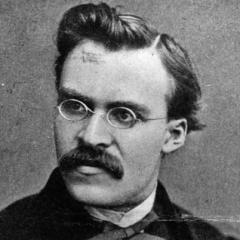
Friedrich Nietzsche

Friedrich Nietzsche Quotes

Philologist

Filter quotes by topic

Famous Friedrich Nietzsche Quotes

“...we then find the sovereign individual as the ripest fruit on its tree, like only to itself, having freed itself from the morality of custom, an autonomous, supra-ethical individual (because ‘autonomous’ and ‘ethical’ are mutually exclusive), in short, we find a man with his own, independent, enduring will, whose prerogative it is to promise – and in him a proud consciousness quivering in every muscle of what he has finally achieved and incorporated, an actual awareness of power and freedom, a feeling that man in general has reached completion.”

“My conception of freedom. - The value of a thing sometimes lies not in what one attains with it, but in what one pays for it - what it costs us. I give an example. Liberal institutions immediately cease to be liberal as soon as they are attained: subsequently there is nothing more thoroughly harmful to freedom than liberal institutions. One knows, indeed, what they bring about: they undermine the will to power, they are the levelling of mountain and valley exalted to a moral principle, they make small, cowardly and smug - it is the herd animal which triumphs with them every time.”

“Let us, in our character of knowers, not be ungrateful towards such determined reversals of the ordinary perspectives and values, with which the mind had for too long raged against itself with an apparently futile sacrilege! In the same way the very seeing of another vista, the very wishing to see another vista, is no little training and preparation of the intellect for its eternal "Objectivity" — objectivity being understood not as "contemplation without interest" (for that is inconceivable and nonsensical), but as the ability to have the pros and cons in one's power and to switch them on and off, so as to get to know how to utilise, for the advancement of knowledge, the difference in the perspective and in the emotional interpretations. But let us, forsooth, my philosophic colleagues, henceforward guard ourselves more carefully against this mythology of dangerous ancient ideas, which has set up a "pure, will-less, painless, timeless subject of knowledge"; let us guard ourselves from the tentacles of such contradictory ideas as "pure reason," "absolute spirituality," "knowledge-in-itself": — in these theories an eye that cannot be thought of is required to think, an eye which ex hypothesi has no direction at all, an eye in which the active and interpreting functions are cramped, are absent; those functions, I say, by means of which "abstract" seeing first became seeing something; in these theories consequently the absurd and the nonsensical is always demanded of the eye. There is only a seeing from a perspective, only a "knowing" from a perspective, and the more emotions we express over a thing, the more eyes, different eyes, we train on the same thing, the more complete will be our "idea" of that thing, our "objectivity." But the elimination of the will altogether, the switching off of the emotions all and sundry, granted that we could do so, what! would not that be called intellectual castration?”

“Ecce homo; si, aquí tenéis al hombre, podéis mirarlo; pero no olvidéis que bajo su humana figura se esconde un dios… Aquí estoy yo, el primer espíritu del siglo, olvidado y despreciado por todos vosotros; soy un desconocido, a pesar de mi grandeza; incluso camino rápidamente hacia la cruz: hacia la demencia, que pronto me arrastrará a sus tinieblas. Mas a pesar de vuestro olvido y vuestro desprecio, «yo soy un destino», soy el heraldo de una nueva época, sobre mí pesa una responsabilidad indecible … Pues yo llevo sobre mis espaldas el destino de la humanidad”

“The will to a system: expressed morally, a more refined corruption with philosophers, an illness of character; expressed unmorally, his will to appear stupider than he is. Stupider, that means stronger, simpler, more dominating, less cultured, more commanding, more tyrannical.”

“Last Words. It will be recollected that the Emperor Augustus, that terrible man, who had himself as much in his own power and could be silent as well as any wise Socrates, became indiscreet about himself in his last words; for the first time he let his mask fall, when he gave to understand that he had carried a mask and played a comedy, - he had played the father of his country and wisdom on the throne well, even to the point of illusion! Plaudite amici, comoedia finita est! - The thought of the dying Nero: qualis artifexpereo! was also the thought of the dying Augustus: histrionic conceit! histrionic loquacity! And the very counterpart to the dying Socrates! - But Tiberius died silently, that most tortured of all self-torturers, - he was genuine and not a stage-player! What may have passed through his head in the end! Perhaps this: " Life - that is a long death. I am a fool, who shortened the lives of so many! Was I created for the purpose of being a benefactor? I should have given them eternal life: and then I could have seen them dying eternally. I had such good eyes for that: qualis spectator pereo!" When he seemed once more to regain his powers after a long death-struggle, it was considered advisable to smother him with pillows, - he died a double death.”

“Ich lehre euch den Übermenschen. Der Mensch ist Etwas, das überwunden werden soll. Was habt ihr gethan, ihn zu überwinden? Was ist der Affe für en Menschen? Ein Gelächter oder eine schmerzliche Scham. Und ebendas soll der Mensch für den Übermenschen sein: ein Gelächter oder eine schmerzliche Scham. Ihr habt den Weg vom Wurme zum Menschen gemacht, und Vieles ist in euch noch Wurm. Einst wart ihr Affen, und auch jetzt ist der Mensch mehr Affe, als irgend ein Affe.”

“The happiness of man is: I will. The happiness of woman is: he wills. ‘Behold, just now the world became perfect!’—thus thinks every woman when she obeys out of entire love. And women must obey and find a depth for her surface. Surface is the disposition of woman: a mobile, stormy film over shallow water. Man’s disposition, however, is deep; his river roars in subterranean caves: woman feels his strength but does not comprehend it.”

“The ground for morality can only be prepared when a greater individual or collective-individual, as, for example, society or state, subjects the individuals in it, that is, when it draws them out of their isolatedness and integrates them into a union. Force precedes morality; indeed, for a time morality itself is a force, to which others acquiesce to avoid unpleasere. Later it becomes custom, and still later free obedience and finally almost instinct: then it is coupled to pleasure, like all habitual and natural things, and is now called virtue.”

“Virtue is under certain circumstances merely an honorable form of stupidity: who could be ill-disposed toward it on that account? And this kind of virtue has not been outlived even today. A kind of sturdy peasant simplicity, which, however, is possible in all classes and can be encountered only with respect and a smile, believes even today that everything is in good hands, namely in the "hands of God"; and when it maintains this proportion with the same modest certainty as it would that two and two make four, we others certainly refrain from contradicting. Why disturb THIS pure foolishness? Why darken it with our worries about man, people, goal, future? And even if we wanted to do it, we could not. They project their own honorable stupidity and goodness into the heart of things (the old God, deus myops, still lives among them!); we others — we read something else into the heart of things: our own enigmatic nature, our contradictions, our deeper, more painful, more mistrustful wisdom.”

“The power of the press consists in the fact that every individual who serves it feels only slightly pledged or bound to it. He usually gives his opinion, but sometimes does not give it, in order to help his party or the politics of his country, or even himself....a man who has money and influence can turn any opinion into the public one. Whoever realises that most people are weak in small things, and wants to attain his own purposes through them, is always a dangerous human being.”

“Even a man who makes the most modest pretensions to integrity must know that a theologian, a priest, a pope of today not only errs when he speaks, but actually lies— and that he no longer escapes blame for his lie through “innocence” or “ignorance.” The priest knows, as every one knows, that there is no longer any “God,” or any “sinner,” or any “Saviour”— that “free will” and the “moral order of the world” are lies —: serious reflection, the profound self-conquest of the spirit, allow no man to pretend that he does not know it. . . . All the ideas of the church are now recognized for what they are — as the worst counterfeits in existence, invented to debase nature and all natural values; the priest himself is seen as he actually is — as the most dangerous form of parasite, as the venomous spider of creation. . . . We know, our conscience now knows — just what the real value of all those sinister inventions of priest and church has been and what ends they have served, with their debasement of humanity to a state of self-pollution, the very sight of which excites loathing — the concepts “the other world,” “the last judgment,” “the immortality of the soul,” the “soul” itself: they are all merely so many instruments of torture, systems of cruelty, whereby the priest becomes master and remains master. . . .”

“My thoughts on the descent of our moral prejudices – for that is what this polemic is about – were first set out in a sketchy and provisional way in the collection of aphorisms entitled Human, All Too Human. A Book for Free Spirits, which I began to write in Sorrento during a winter that enabled me to pause, like a wanderer pauses, to take in the vast and dangerous land through which my mind had hitherto travelled. This was in the winter of 1876–7; the thoughts themselves go back further. They were mainly the same thoughts which I shall be taking up again in the present essays – let us hope that the long interval has done them good, that they have become riper, brighter, stronger and more perfect! The fact that I still stick to them today, and that they themselves in the meantime have stuck together increasingly firmly, even growing into one another and growing into one, makes me all the more blithely confident that from the first, they did not arise in me individually, randomly or sporadically but as stemming from a single root, from a fundamental will to knowledge deep inside me which took control, speaking more and more clearly and making ever clearer demands. And this is the only thing proper for a philosopher. We have no right to stand out individually: we must not either make mistakes or hit on the truth individually. Instead, our thoughts, values, every ‘yes’, ‘no’, ‘if ’ and ‘but’ grow from us with the same inevitability as fruits borne on the tree – all related and referring to one another and a testimonial to one will, one health, one earth, one sun. – Do you like the taste of our fruit? – But of what concern is that to the trees? And of what concern is it to us philosophers? . . .”

“New struggles. -- After Buddha was dead, they still showed his shadow in a cave for centuries -- a colossal, horrible shadow. God is dead, but given the way people are, there may still be caves for millennia in which his shadow is displayed. -- And we -- we must still defeat his shadow as well!”

“Have you ever heard of the madman who on a bright morning lighted a lantern and ran to the market-place calling out unceasingly: "I seek God! I seek God!"—As there were many people standing about who did not believe in God, he caused a great deal of amusement. Why! is he lost? said one. Has he strayed away like a child? said another. Or does he keep himself hidden? Is he afraid of us? Has he taken a sea-voyage? Has he emigrated?—the people cried out laughingly, all in a hubbub. The insane man jumped into their midst and transfixed them with his glances. "Where is God gone?" he called out. "I mean to tell you! We have killed him,—you and I! We are all his murderers! But how have we done it? How were we able to drink up the sea? Who gave us the sponge to wipe away the whole horizon? What did we do when we loosened this earth from its sun? Whither does it now move? Whither do we move? Away from all suns? Do we not dash on unceasingly? Back-wards, sideways, forewards, in all directions? Is there still an above and below? Do we not stray, as through infinite nothingness? Does not empty space breathe upon us? Has it not become colder? Does not night come on continually, darker and darker? Shall we not have to light lanterns in the morning? Do we not hear the noise of the grave-diggers who are burying God? Do we not smell the divine putrefaction?—for even Gods putrefy! God is dead! God remains dead! And we have killed him! How shall we console ourselves, the most murderous of all murderers? The holiest and the mightiest that the world has hitherto possessed, has bled to death under our knife,—who will wipe the blood from us? With what water could we cleanse ourselves? What lustrums, what sacred games shall we have to devise? Is not the magnitude of this deed too great for us? Shall we not ourselves have to become Gods, merely to seem worthy of it? There never was a greater event,—and on account of it, all who are born after us belong to a higher history than any history hitherto!"—Here the madman was silent and looked again at his hearers; they also were silent and looked at him in surprise. At last he threw his lantern on the ground, so that it broke in pieces and was extinguished. "I come too early," he then said, "I am not yet at the right time. This prodigious event is still on its way, and is travelling,—it has not yet reached men's ears. Lightning and thunder need time, the light of the stars needs time, deeds need time, even after they are done, to be seen and heard. This deed is as yet further from them than the furthest star,—and yet they have done it!"—It is further stated that the madman made his way into different churches on the same day, and there intoned his Requiem æternam deo. When led out and called to account, he always gave the reply: "What are these churches now, if they are not the tombs and monuments of God?”

“Besides this I place another equally obvious confirmation of my view that opera is based on the same principles as our Alexandrian culture. Opera is the birth of the theoretical man, the critical layman, not of the artist: one of the most surprising facts in the history of all the arts. It was the demand of throughly unmusical hearers that before everything else the words must be understood, so that according to them a rebirth of music is to be expected only when some mode of singing has been discovered in which textword lords it over counterpoint like master over servant: For the words, it is argued, are as much nobler than the accompanying harmonic system as the soul is nobler than the body.”

“Origin of the Logical. Where has logic originated in men’s heads? Undoubtedly out of the illogical, the domain of which must originally have been immense. But numberless beings who reasoned otherwise than we do at present, perished; albeit that they may have come nearer to truth than we! Whoever, for example, could not discern the "like" often enough with regard to food, and with regard to animals dangerous to him, whoever, therefore, deduced too slowly, or was too circumspect in his deductions, had smaller probability of survival than he who in all similar cases immediately divined the equality. The preponderating inclination, however, to deal with the similar as the equal - an illogical inclination, for there is no thing equal in itself - first created the whole basis of logic. It was just so (in order that the conception of substance should originate, this being indispensable to logic, although in the strictest sense nothing actual corresponds to it) that for a long period the changing process in things had to be overlooked, and remain unperceived; the beings not seeing correctly had an advantage over those who saw everything "in flux." In itself every high degree of circumspection in conclusions, every sceptical inclination, is a great danger to life. No living being might have been preserved unless the contrary inclination - to affirm rather than suspend judgment, to mistake and fabricate rather than wait, to assent rather than deny, to decide rather than be in the right - had been cultivated with extraordinary assiduity. - The course of logical thought and reasoning in our modern brain corresponds to a process and struggle of impulses, which singly and in themselves are all very illogical and unjust; we experience usually only the result of the struggle, so rapidly and secretly does this primitive mechanism now operate in us.”

“...Originally everything about a Greek or Christian building meant something, and in reference to a higher order of things. This atmosphere of inexhaustible meaningfulness hung about the building like a magic veil. Beauty entered the system only secondarily, impairing the basic feeling of uncanny sublimity, of sanctification by magic or the gods' nearness. At the most, beauty tempered the dread - but this dread was the prerequisite everywhere. What does the beauty of a building mean to us now? The same as the beautiful face of a mindless woman: something masklike.”

“In order that the concept of substance could originate--which is indispensable for logic although in the strictest sense nothing real corresponds to it--it was likewise necessary that for a long time one did not see or perceive the changes in things. The beings that did not see so precisely had an advantage over those who saw everything "in flux." At bottom, every high degree of caution in making inferences and every skeptical tendency constitute a great danger for life. No living beings would have survived if the opposite tendency--to affirm rather than suspend judgment, to err and make up things rather than wait, to assent rather than negate, to pass judgment rather than be just-- had not been bred to the point where it became extraordinarily strong.”