Quotessence
Home / Authors / John McPhee Books
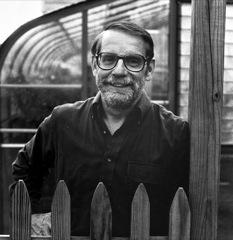
John McPhee

John McPhee Books

Writer

Silk Parachute

A source page for quotes linked to John McPhee.
0 quotes

Related Quotes

“In the view of conservationists, there is something special about dams, something—as conservation problems go—that is disproportionately and metaphysically sinister. The outermost circle of the Devil’s world seems to be a moat filled mainly with DDT. Next to it is a moat of burning gasoline. Within that is a ring of pinheads each covered with a million people—and so on past phalanxed bulldozers and bicuspid chain saws into the absolute epicenter of Hell on earth, where stands a dam.”

“So, a little desperate and surprisingly inspired, I bought a cap. Not just any cap. I picked one with a bright-gold visor, a gold button at the top, a crown of navy blue, an American flag on the left temple, and—on the forehead emblem—a spread-winged eagle over a rising sun and a red-and-green tractor-trailer and the white letters “America— Spirit of Freedom.” On the back, over my cerebellum, was a starred banner in blue, white, red, green, and gold that said “Carnesville, GA Petro.” I put on that hat and disappeared. The glances died like flies. I could sit anywhere, from Carnesville to Tacoma. In Candler, North Carolina, while Ainsworth was outside fuelling the truck, I sat inside in my freedom hat saying “Biscuits and gravy” to a waitress. She went “Oooooo wheeeee” and I thought my cover wasn’t working, but a trucker passing her had slipped his hand between the cheeks of her buttocks, and she did not stop writing.”

“The Himalayas are the crowning achievement of the Indo-Australian plate. India in the Oligocene crashed head on into Tibet, hit so hard that it not only folded and buckled the plate boundaries but also plowed into the newly created Tibetan plateau and drove the Himalayas five and a half miles into the sky. The mountains are in some trouble. India has not stopped pushing them, and they are still going up. Their height and volume are already so great they are beginning to melt in their own self-generated radioactive heat. When the climbers in 1953 planted their flags on the highest mountain, they set them in snow over the skeletons of creatures that had lived in a warm clear ocean that India, moving north, blanked out. Possibly as much as 20,000 feet below the sea floor, the skeletal remains had turned into rock. This one fact is a treatise in itself on the movements of the surface of the earth. If by some fiat, I had to restrict all this writing to one sentence; this is the one I would choose: the summit of Mount Everest is marine limestone.”

“Turbines designed for low-flow situations would be wasteful in times of high water. Turbines designed for high efficiency at, say, five hundred cubic feet per second might be ineffective in times of low water. Under certain conditions, turbines can go into a state of cavitation, wherein vaporizing water creates bubbles that implode on the metal and riddle it with tiny holes. The ideal turbine for a little mill up a creek somewhere in inconsistent country would be one that was prepared to take whatever might come, to sit there and react calmly in any situation, to respond evenly to wild and sudden demands, to make the best of difficult circumstances, to remain steadfast in time of adversity, to keep going, above all to press on, to persevere, and not vibrate, fibrillate, vacillate, cavitate, or panic - in short, to accept with versatile competence what is known in hydroelectrical engineering as the run of the river.”

“A quarter-horse jockey learns to think of a twenty-second race as if it were occurring across twenty minutes--in distinct parts, spaced in his consciousness. Each nuance of the ride comes to him as he builds his race. If you can do the opposite with deep time, living in it and thinking in it until the large numbers settle into place, you can sense how swiftly the initial earth packed itself together, how swiftly continents have assembled and come apart, how far and rapidly continents travel, how quickly mountains rise and how quickly they disintegrate and disappear.”

“Travel by canoe is not a necessity, and will nevermore be the most efficient way to get from one region to another, or even from one lake to another anywhere. A canoe trip has become simply a rite of oneness with certain terrain, a diversion off the field, an art performed not because it is a necessity but because there is value in the art itself.”

“On the geological time scale, a human lifetime is reduced to a brevity that is too inhibiting to think about deep time. ... Geologists ... see the unbelievable swiftness with which one evolving species on the Earth has learned to reach into the dirt of some tropical island and fling 747s across the sky ... Seeing a race unaware of its own instantaneousness in time, they can reel off all the species that have come and gone, with emphasis on those that have specialized themselves to death.”

“On a certain scale, it does look like I do a lot. But that’s my day, all day long, sitting there wondering when I’m going to be able to get started. And the routine of doing this six days a week puts a little drop in a bucket each day, and that’s the key. Because if you put a drop in a bucket every day, after three hundred and sixty-five days, the bucket’s going to have some water in it.”

“When the climbers in 1953 planted their flags on the highest mountain, they set them in snow over the skeletons of creatures that had lived in the warm clear ocean that India, moving north, blanked out. Possibly as much as twenty thousand feet below the seafloor, the skeletal remains had turned into rock. This one fact is a treatise in itself on the movements of the surface of the earth. If by some fiat I had to restrict all this writing to one sentence, this is the one I would choose: The summit of Mt. Everest is marine limestone.”