Quotessence
Home / Authors / John Updike Books
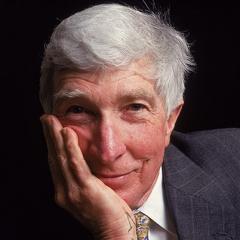
John Updike

John Updike Books

Novelist

Related Quotes

“Momentarily drained of lust, he stares at the remembered contortions to which it has driven him. His life seems a sequence of grotesque poses assumed to no purpose, a magic dance empty of belief. There is no God; Janice can die: the two thoughts come at once, in one slow wave. He feels underwater, caught in chains of transparent slime, ghosts of the urgent ejaculations he has spat into the mild bodies of women. His fingers on his knees pick at persistent threads.”

“Harry, I’m sorry for whatever pain this is causing you, truly sorry, but it’s very important that at this point in our lives we don’t let guilt feelings motivate us. I’m trying to look honestly into myself, too see who I am, and where I should be going. I want us both, Harry, to come to a decision we can live with. It’s the year nineteen sixty-nine and there’s no reason for two mature people to smother each other to death simply out of inertia. I’m searching for a valid identity and I suggest you do the same.”

“I never heard enough damnation from your pulpit. Many mornings I had to strain to take hold of what you were saying, Reverend. I couldn't figure it out, and got dizzy listening, the way you were dodging here and there. A lot of talk about compassion for the less fortunate, I remember that. Never a healthy sign, to my way of thinking, too much fuss and feathers about the poor. They're with us always, the Lord Himself said. Wait till the next go-around, if the poor feel so sorry for themselves on this. The first shall be last. Take away damnation, in my opinion, a man might as well be an atheist. A God that can't damn a body to an eternal Hell can't lift a body up out of the grave either.”

“As long as Nelson was socked into baseball statistics or that guitar or even the rock records that threaded their sound through all the fibers of the house, his occupation of the room down the hall was no more uncomfortable than the persistence of Rabbit's own childhood in an annex of his brain; but when the stuff with hormones and girls and cars and beers began, Harry wanted out of fatherhood.”

“He sees now that he is rich that these were the [shore] outings of the poor, ending in sunburn and stomach upset. Pop liked crabcakes and baked oysters but could never eat them without throwing up. When the Model A was tucked into the garage and little Mim tucked into bed Harry could hear his father vomiting in a far corner of the yard. He never complained about vomiting or about work, they were just things you had to do, one more regularly than the other.”

“Oblong cocooned little visitor, the baby shows her profile blindly in the shuddering flashes of color jerking from the Sony, the tiny stitchless seam of the closed eyelid aslant, lips bubbled forward beneath the whorled nose as if in delicate disdain, she knows she’s good. You can feel in the curve of the cranium she’s feminine, that shows from the first day. Through all this she has pushed to be here, in his lap, his hands, a real presence hardly weighing anything but alive. Fortune’s hostage, heart’s desire, a granddaughter. His. Another nail in his coffin. His.”

“This got him to the door. There, ridiculously, he turned. It was only at the door, he decided in retrospect, that her conduct was quite in excusable: not only did she stand unncessarily close, but, by shifting the weight of her body to one leg and leaning her head sidewise, she lowered her height several inches, placing him in a dominating position exactly suited to the broad, passive shadows she must have known were on her face." (“Snowing in Greenwich Village")”

“...little is more precious in an affair for a man than being welcomed into a house he has done nothing to support, or more momentous for the woman than this welcoming, this considered largesse, her house his, his on the strength of his cock alone, his cock and company, the smell and amusement and weight of him — no buying you with mortgage payments, no blackmailing you with shared children, but welcomed simply, into the walls of yourself, an admission dignified by freedom and equality.”

“Dabbling in the sandbox gives Rabbit a small headache. Over at the pavilion the rubber thump of Roofball and the click of checkers call to his memory, and the forgotten smell of that narrow plastic ribbon you braid bracelets and whistlechains out of and of glue and of the sweat on the handles on athletic equipment is blown down by a breeze laced with children's murmuring. He feels the truth: the thing that has left his life has left irrevocably; no search would recover it. No flight would reach it. It was here, beneath the town, in these smells and these voices, forever behind him. The fullness ends when we give Nature her ransom, when we make children for her. Then she is through with us, and we become, first inside, and then outside, junk. Flower stalks.”

“Slim is queer and though Nelson isn't supposed to mind that he does. He also minds that there are a couple of slick blacks making it at the party and that one little white girl with that grayish kind of sharp-chinned Polack face from the south side of Brewer took off her shirt while dancing even though she has no tits to speak of and now sits in the kitchen with still bare tits getting herself sick on Southern Comfort and Pepsi. At these parties someone is always in the bathroom being sick or giving themselves a hit or a snort and Nelson minds this too. He doesn't mind any of it very much, he's just tired of being young. There's so much wasted energy to it.”

“Poor old Nixon, even his own commissions beat on him. What the hell can he do? He can’t go into every ghetto and fix the plumbing himself. He can’t give every copped-out junkie a million dollars and a Ph.D. Nixon, who’s Nixon? He’s just a typical flatfooted Chamber of Commerce type who lucked his way into the hot seat and is so dumb he thinks it’s good luck. Let the poor bastard alone, he’s trying to bore us to death so we won’t commit suicide.”

“When he was about twelve or thirteen he walked into his parents' bedroom in the half-house on Jackson Road not expecting his father to be there, and the old man was standing in front of his bureau in just socks and an undershirt, innocently fishing in a drawer for his undershorts, that boxer style that always looked sad and dreary to Harry anyway, and here was his father's bare behind, such white buttocks, limp and hairless, mute and helpless flesh that squeezed out shit once a day and otherwise hung there in the world like linen that hadn't been ironed....”

“He lost his appetite for reading. He was afraid of being overwhelmed again. In mystery novels people died like dolls being discarded; in science fiction enormities of space and time conspired to crush the humans ; and even in P.G. Wodehouse he felt a hollowness, a turning away from reality that was implicitly bitter, and became explicit in the comic figures of futile parsons.”

“Teddy was reminded of Paterson, but that polyglot population had appeared healthier, more hopeful, the American mood more fertile then in its promises, and the streets of Silk City with their little yards holding a fuchsia bush or a blue-robed plaster statue of the Virgin more livable than these stacked, stinking, ill-lit dens. He had been a part of the population then, a schoolboy immersed in its details of competition and expectation and childish collusion and hierarchy, alive in its struggle and too absorbed to judge or pity, whereas now he came upon it from outside, from above, as an agent of power and ownership, an enforcer and avenger, the representative of the system which squeezed the lowly by the same iron laws whereby it generation profits for the lucky and strong.”

“The thing about her is, she’s good-natured. He knew it the second he saw her standing by the parking meters. He could just tell from the soft way her belly looked. With women, you keep bumping against them, because they want different things, they’re a different race. Either they give, like a plant, or scrape, like a stone. In all the green world nothing feels as good as a woman’s good nature.”

“I don’t think about politics,” Rabbit says. “That’s one of my Goddam precious American rights, not to think about politics. I just don’t see why we’re supposed to walk down the street with our hands tied behind our back and let ourselves be blackjacked by every thug who says he has a revolution going. And it really burns me up to listen to hotshot crap-car salesmen dripping with Vitalis sitting on their plumped-up asses bitching about a country that’s been stuffing goodies into their mouth ever since they were born.”

“The voice welling up out of this little man is terrific, Harry had noticed it at the house, but here, in the nearly empty church, echoing off the walnut knobs and memorial plaques and high arched rafters, beneath the tall central window of Jesus taking off into the sky with a pack of pastel apostles for a launching pad, the timbre is doubled, richer, with a rounded sorrowful something Rabbit hadn't noticed hitherto, gathering and pressing the straggle of guests into a congregation, subduing any fear that this ceremony might be a farce. Laugh at ministers all you want, they have the words we need to hear, the ones the dead have spoken.”

“Harry has heard this before. Thelma's voice is dutiful and deliberately calm, issuing small family talk when both know that what she wants to discuss is her old issue, that flared up a minute ago, of whether he loves her or not, or why at least he doesn't need her as much as she does him. But their relationship at the start was established with her in pursuit of him, and all the years since, of hidden meetings, of wise decisions to end it and thrilling abject collapses back into sex, have not disrupted the fundamental pattern of her giving and his taking, of her fearing their end more than he, and clinging, and disliking herself for clinging, and wanting to punish him for her dislike, and him shrugging and continuing to bask in the sun of her love, that rises every day whether he is there or not. He can't believe it, quite, and has to keep testing her.”

“He imagines the plane exploding as it touches down, ignited by one of its glints, in a ball of red flame shadowed in black like you see on TV all the time, and he is shocked to find within himself, imagining this, not much emotion, just a cold thrill at being a witness, a kind of bleak wonder at the fury of chemicals, and relief that he hadn't been on the plane himself but was instead safe on this side of the glass, with his faint pronged sense of doom.”

“Inside, upstairs, where the planes are met, the spaces are long and low and lined in tasteful felt gray like that cocky stewardess's cap and filled with the kind of music you become aware of only when the elevator stops or when the dentist stops drilling. Plucked strings, no vocals, music that's used to being ignored, a kind of carpet in the air, to cover up a silence that might remind you of death.”

“Le da la sensación de estar rodeado de libertad, de oxígeno. Tothero es como un remolino de aire, y el edificio en el que se encuentra, las calles del pueblo, no son más que escaleras y pasadizos del espacio. Es tan perfecta y coherente la libertad en que se ha convertido el desorden del mundo gracias al simple estallido de su decisión, que todos los caminos parecen buenos, todos los movimientos serán caricias para su piel, y ni un solo átomo de su felicidad se alteraría si Tothero le dijera que en lugar de ir a una cita con dos chicas iban a reunirse con dos machos cabríos, o que no iban a Brewer sino al Tíbet".”