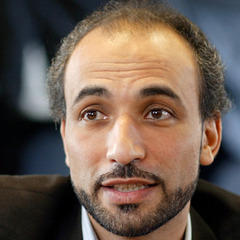
“Islam can only be modernized from within. If I state that I condemn the practice of stoning, that this punishment is despicable, it changes nothing. My fellow Muslims will say: Brother Tariq, you became a European, a Swiss citizen, so you are no longer one of us.” IfsStatesPracticeBrotherCitizensFellowsIslamPunishmentDespicableSwiss Author:Tariq Ramadan
“In my book, the Arab Awakening, I talk about the fact that we have to move from this. All the contemporary ideologies of political Islam have been based on the nation state. The nation state is very problematic but I'm not sure if we have an alternative political model.” IfsHas BeensBookStatesFactsMovingPoliticalNationsModelsIslamAwakeningContemporaryIdeologyAlternativesNot Sure Author:Tariq Ramadan
“Destroying the nation state are mainly three things: the global economy, global communication technology and global culture. And this is where we are lost in the process. What could be something that can provide us a transversal political sense of belonging? At the end of the day, without an alternative we end up with populism in the name of very narrow identities.” EndsStatesPoliticalCultureThreeNamesLostNationsProcessTechnologyEconomyIdentityCommunicationAlternativesThe End Of The DayBelongingDestroyingThree ThingsGlobal EconomyPopulismCommunication Technology Author:Tariq Ramadan
“Now no one can deny the fact that whatever is the state of the affairs in the country, you did not have the army controlling the country and you have a pluralistic society anyway.” CountryStatesFactsArmyAffairDeny Author:Tariq Ramadan
“Saying that the origin of the Islamic State (IS) is within the Muslim Brotherhood organisation only strengthens IS. This is what the Israeli government asserts when claiming that Hamas and IS are the exact same thing. By saying so, the historical resistance [against the Israeli occupation] is viewed as unlawful, called extremism and terrorism.” StatesGovernmentHistoricalTerrorismResistanceIslamicOccupationBrotherhoodIsraeliExtremismOrganisationHamasIslamic StateUnlawfulMuslim BrotherhoodIsraeli Occupation Author:Tariq Ramadan
“IS [Islamic State] has played a major role in helping Bashar al-Assad to reposition Syria on the international scene. Now, it is almost impossible to come up with a solution that would exclude him. The political game appears to be very cynical indeed.” StatesHelpingPoliticalGamesRolesImpossibleSceneMajorsSolutionsInternationalCome UpIslamicAlsCynicalSyriaAssadIslamic StatePolitical GamesBashar Al Assad Author:Tariq Ramadan
“The fact that this organisation is called the Islamic State reveals something even deeper. In fact, it implies that every single Islamist party in Egypt, Iraq or Tunisia are not really representing Islam and Muslim people. Nowadays, political Islam is going through a crisis, however this crisis is necessary, for it will lead to a changing way of thinking. In order to make it out of this dead-end, reviewing political Islam becomes mandatory.” PeopleThinkingWayEndsStatesFactsPoliticalOrderPartyCrisisIslamIraqDeeperIslamicEgyptWay Of ThinkingOrganisationRepresentingDead EndsIslamistsIslamic StateTunisia Author:Tariq Ramadan
“We have talked about revoking French citizenship for some individuals. Therefore, I have decided to apply for citizenship, which in a way points out the contradictions of this bill that states the forfeiture of French citizenship exclusively to individuals holding dual nationalities. Through this application, I put myself in the midst of the French political debate and discredit everything that might be said against me about this matter.” WaySaidMatterStatesMightPoliticalIndividualDecidedBillsDebateContradictionMidstApplicationCitizenshipNationalityDiscreditPolitical Debates Author:Tariq Ramadan
“The nature of the state is one thing, but there are other major challenges - what it will take to tackle the issues of social corruption, for example, social justice, and the economic system - and what are the future challenges when it comes to equality between the citizens, in particular in the field of the job market and equal opportunity for men and for women? This is at the centre of the question that is the Arab Awakening.” MenStatesJobsOpportunitySocialChallengesJusticeIssuesOne ThingEconomicExampleFieldsParticularCitizensEqualMajorsSocial JusticeCorruptionAwakeningCentreEconomic SystemsEqual Opportunity Author:Tariq Ramadan
“I wouldn't call it naive but silly. History does not work like this. If you look at the dynamics of Eastern Europe or even Germany post reunification, you realize that change takes time. No one can deny the fact that we are still not there - I am advocating something which has to go from uprisings to revolutions. It is not coming straight away that it is not going to come but what we have to advocate is that the democratization process is always better than state dictatorship.” IfsLooksDoeStillsStatesFactsProcessRealizingRevolutionEuropeDenySillyPostsGermanyTake TimeDictatorshipEasternDynamicsAdvocatingUprisingEastern EuropeDemocratizationReunification Author:Tariq Ramadan
“Saying that the origin of the Islamic State (IS) is within the Muslim Brotherhood organisation only strengthens IS.” StatesIslamicBrotherhoodOrganisationIslamic StateMuslim Brotherhood Author:Tariq Ramadan
“In fact all the Islamists, that is the reformists not the Salafis, now they all say that they want a civil state, a civil state with Islamic reference points. They are not talking about an Islamic state, or sharia in the way this was once understood in the fight against the colonisers, or just afterwards in the 70's, 80's and 90's.” WayWantStatesFactsFightingTalkingUnderstoodIslamicNot TalkingIslamistsIslamic StateSharia Author:Tariq Ramadan
“I think many thinkers and activists, even in the Islamist parties like the Muslim Brotherhood, and the people who left the Muslim Brotherhood to follow Abou el-Fatouh, these people do have an understanding that the relationship between religion and the state must be re-thought and re-assessed. They're not going to use the concept of secularism in any straightforward way, because the concept of secularism is still far too loaded in that part of the world.” PeopleThinkingWorldWayStillsStatesUseLeftUnderstandingPartyConceptsActivistThinkerBrotherhoodSecularismStraightforwardLoadedIslamistsMuslim Brotherhood Author:Tariq Ramadan
“Even after the whole democratization process, it's quite clear that the United States are not seen in a positive way in all the Muslim-majority countries - in Egypt, in Libya, even in Tunisia - even though we have now a kind of trying to be recognized as democrats by the Islamists who are running, you know, Tunisia and Egypt. But the popular sentiment is very, very negative.” KnowsWayTryingKindCountryStatesWholeRunningProcessUnitedUnited StatesClearNegativeMajorityDemocratSentimentsEgyptLibyaIslamistsDemocratizationTunisia Author:Tariq Ramadan
“Populism is everywhere. We have religious populism in the Muslim-majority countries as much as we have populism in the United States of America.” CountryStatesAmericaReligiousUnitedUnited StatesMajorityUnited States Of AmericaPopulism Author:Tariq Ramadan
“The United States of America or the Western countries, they don't have a problem with Islamists as long as they are neoliberal capitalists and promoting the economic order. And the best example is the petro-monarchies. The petro-monarchies, they don't want democracy. They say there is no democracy in Islam. But they are within the economic system.” WantLongCountryStatesProblemAmericaOrderUnitedUnited StatesDemocracyEconomicExampleIslamWesternCapitalistUnited States Of AmericaPromotingMonarchyEconomic SystemsIslamistsEconomic Order Author:Tariq Ramadan
“You can't have anything happening today within the petro-monarchies, is going to be too risky for the United States and the oil interests there.” StatesTodayInterestUnitedUnited StatesHappeningsOilMonarchy Author:Tariq Ramadan
“The BRIC countries - Brazil, India, China, Turkey, South Africa, Indonesia even, and Russia - are now new actors. Over the last eight years, China multiplied by seven its economic presence and penetration in the Middle East. And if this happens on economic terms and there is a shift towards the East, the relationship between these countries and Israel is completely different from the United States. And it means that the challenges are going to be different, because China is not supporting Israel the way the U.S. are supporting Israel.” IfsWayYearsMeanDifferentCountryStatesHappensLastsActorsTermChallengesUnitedUnited StatesEconomicMiddleIndiaSouthSevenIsraelChinaEightEastRussiaMiddle EastSouth AfricaTurkeysIndonesiaBrazilPenetrationBrics Author:Tariq Ramadan