Quotessence
Home / Authors / Thomas Jefferson
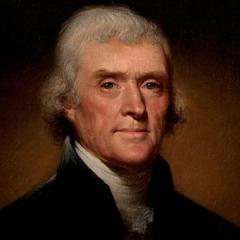
Thomas Jefferson

Thomas Jefferson Quotes

3rd U.S. President

Filter quotes by topic

Famous Thomas Jefferson Quotes

“That peace, safety, and concord may be the portion of our native land, and be long enjoyed by our fellow-citizens, is the most ardent wish of my heart, and if I can be instrumental in procuring or preserving them, I shall think I have not lived in vain.”

“The constitutions of most of our States assert, that all power is inherent in the people; that they may exercise it by themselves, in all cases to which they think themselves competent, or they may act by representatives, freely and equally chosen; that it is their right and duty to be at all times armed; that they are entitled to freedom of person, freedom of religion, freedom of property, and freedom of the press.”

“If [God] has made it a law in the nature of man to pursue his own happiness, He has left him free in the choice of place as well as mode, and we may safely call on the whole body of English jurists to produce the map on which nature has traced for each individual the geographical line which she forbids him to cross in pursuit of happiness.”

“The true fountains of evidence [are] the head and heart of every rational and honest man. It is there nature has written her moral laws, and where every man may read them for himself.”

“God has formed us moral agents... that we may promote the happiness of those with whom He has placed us in society, by acting honestly towards all, benevolently to those who fall within our way, respecting sacredly their rights, bodily and mental, and cherishing especially their freedom of conscience, as we value our own.”

“But, you may ask, if the two departments [i.e., federal and state] should claim each the same subject of power, where is the common umpire to decide ultimately between them? In cases of little importance or urgency, the prudence of both parties will keep them aloof from the questionable ground; but if it can neither be avoided nor compromised, a convention of the States must be called to ascribe the doubtful power to that department which they may think best.”

“The most fortunate of us, in our journey through life, frequently meet with calamities and misfortunes which may greatly afflict us; and, to fortify our minds against the attacks of these calamities and misfortunes, should be one of the principal studies and endeavors of our lives.”

“History by apprising them [the people] of the past will enable them to judge of the future. . . . It will qualify them as judges of the actions and designs of men: it will enable them to know ambition under every disguise it may assume; and knowing it, to defeat its views.”

“Our public credit is good, but the abundance of paper has produced a spirit of gambling in the funds, which has laid up our ships at the wharves as too slow instruments of profit, and has even disarmed the hand of the tailor of his needle and thimble. They say the evil will cure itself. I wish it may; but I have rarely seen a gamester cured, even by the disasters of his vocation.”

“Up until the late unpleasantness of the Civil war, then, the right of secession was more or less taken for granted in many quarters, and there has never been any amendment or even a Supreme Court decision saying it's improper. - Samual Francis, Secession May Be Legal But Not Expedient, Conservative Chronicles If there be any among us who wish to dissolve the Union or to change its republican form, let them stand undisturbed, as monuments of the safety with which error of opinion may be tolerated where reason is left free to combat it.”

“With all the defects in our Constitution, whether general or particular, the comparison of our government with those of Europe, is like a comparison of Heaven with Hell. England, like the earth, may be allowed to take the intermediate station.”

“It is comfortable to see the standard of reason at length erected, after so many ages, during which the human mind has been held in vassalage by kings, priests, and nobles; and it is honorable for us to have produced the first legislature who had the courage to declare that the reason of man may be trusted with the formation of his own opinions.”

“The God who gave us life, gave us liberty at the same time; the hand of force may destroy, but cannot disjoin them. ... Love your neighbor as yourself and your country more than yourself. ... The boisterous sea of liberty is never without a wave. ... I have sworn upon the altar of God, eternal hostility against every form of tyranny over the mind of man. ... The tree of liberty must be refreshed from time to time with the blood of patriots and tyrants. It is its natural manure.”

“The true theory of our Constitution is surely the wisest and best, that the States are independent as to everything within themselves, and united as to everything respecting foreign affairs. Let the General Government be reduced to foreign concerns only, and let our affairs be disentangled from those of all other nations, except as to commerce, which the merchants will manage the better, the more they are left free to manage for themselves, and our General Government may be reduced to a very simple organization, and a very inexpensive one; a few plain duties to be performed by a few servants.”

“That this privilege of giving or of withholding our monies is an important barrier against the undue exertion of prerogative, which if left altogether without control may be exercised to our great oppression; and all history shews how efficacious is its intercession for redress of grievances and re-establishment of rights, and how improvident would be the surrender of so powerful a mediator”

“As, for the safety of society, we commit honest maniacs to Bedlam, so judges should be withdrawn from their bench, whose erroneous biases are leading us to dissolution. It may indeed injure them in fame or in fortune; but it saves the republic, which is the first and supreme law.”

“The earth belongs to the living. No man can, by natural right, oblige the lands he occupied or the persons who succeed him in that occupation, to the payment of debts contracted by him. For if he could, he might, during his own life, eat up the use of the lands for several generations to come, and then the lands would belong to the dead, and not to the living. No generation can contract debts greater than may be paid during the course of its own existence.”

“Political dissension is doubtless a less evil than the lethargy of despotism: but still it is a great evil, and it would be as worthy the efforts of the patriot as of the philosopher, to exclude its influence if possible, from social life. The good are rare enough at best. There is no reason to subdivide them by artificial lines. But whether we shall ever be able so far to perfect the principles of society as that political opinions shall, in its intercourse, be as inoffensive as those of philosophy, mechanics, or any other, may well be doubted.”