Quotessence
Home / Quotes / Quote by Samson Raphael Hirsch

Quote by Samson Raphael Hirsch

Author

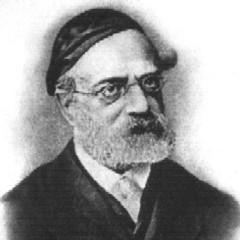
Samson Raphael Hirsch

Samson Raphael Hirsch, born on June 20, 1808, and died on December 31, 1888, was a prominent rabbi and Jewish scholar. Known for his profound research and innovative interpretations of the Jewish Torah, Hirsch had a significant impact on the revival of Judaism in the 19th century. more

You May Also Like

“The more the Jew is a Jew, the more universalist will his views and aspirations be, the less aloof will he be from anything that is noble and good, true and upright, in art or science, in culture or education; the more joyfully will he applaud whenever he sees truth and justice and peace and the ennoblement of man prevail and become dominant in human society.”

“At present, when the prevailing forms of society have become hindrances to the free expression of human powers, it is precisely the abstract branches of science, mathematics and theoretical physics, which ... offer a less distorted form of knowledge than other branches of science which are interwoven with the pattern of daily life, and the practicality of which seemingly testifies to their realistic character.”

“Although the formulations of science now offer the most advanced knowledge of nature, men continue to use obsolete forms of thought long discarded by scientific theory. In so far as these obsolete forms are superfluous for science, the fact that they persist violated the principle of the economy of thought, that characteristic trait of the bourgeois temper.”

“The endeavor of scientific research to see events in their more general connection in order to determine their laws, is a legitimate and useful occupation. Any protest against such efforts, in the name of freefom from restrictive conditions, would be fruitless if science did not naïvely identify the abstractions called rules and laws with the actually efficacious forces, and confuse the probability that B will follow A with the actual effort make B follow A.”

“Calvin's theocentric irrationalism eventually revealed itself as the cunning to technocratic reason which had to shape its human material. Misery and the poor laws did not suffice to drive men into the workshops of the early capitalistic era. The new spirit helped to supplement external pressures with a concern for wife and child to which the moral autonomy of the introverted subject in reality was tantamount.”