Quotessence
Home / Quotes / Quote by N. T. Wright

Quote by N. T. Wright

Work

Lent for Everyone: Luke, Year C

This book offers reflections and meditations on the Gospel of Luke during the Lenten season, providing spiritual insights and guidance for readers. more

Author
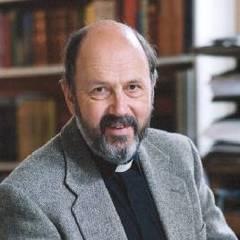
N. T. Wright
N. T. Wright

N.T. Wright, born on December 1, 1948, is a British theologian, writer, and scholar. He served as the Bishop of Durham and is one of the most influential figures in contemporary Christian theology. Wright is known for his in-depth research into the Bible and his contributions to the study of Christian history. more

You May Also Like

“problematic within post-Reformation dogmatics. Is faith something I `do' to earn God's favour, and, if not, what role does it play? Once we release Paul's justification-language from the burden of having to describe `how someone becomes a Christian', however, this is simply no longer a problem. There is no danger of imagining that Christian faith is after all a surrogate `work', let alone a substitute form of moral righteousness. Faith is the badge of covenant membership, not something someone `performs' as a kind of initiation test.”

“the word 'justification' has itself had a chequered career over the course of many centuries of debate. As the major historian of the doctrine has noted, the word has long since ceased to mean, in ecclesial debates, what it meant for Paul himself - which is confusing, since the debates have gone on referring to Paul as though he was in fact talking about what they want to talk about. It is as though the greengrocer treated you to a long discussion of how onions are grown, and how best to cook with them, when what you had asked was how much he would charge for three of them.”

“the life of Jesus recapitulates key elements in the earlier story of Israel. For a moment, as Jesus stands on the mountain giving the famous sermon, he is Moses. For a moment, answering his critics about his actions on the sabbath, he is David. For a moment, as he calls and names the twelve disciples, he is perhaps Jacob, bringing the twelve patriarchs into the world. For a moment, healing the sick and raising the dead, he is Elijah or Elisha. And so on. In the transfiguration he actually meets Moses and Elijah.”

“It shouldn't be difficult, then, to make the transposition at this point into the early Christian vision of Jesus and the Spirit and the way in which the material world is both celebrated and renewed through their work. The Jewish basis for the early Christian patterns of belief and behavior is clear. It is important that God's people are embodied, because God made this world and has no intention of abandoning it. The material of creation is a vessel made to be filled with God's new life and glory, even though the transformation may involve suffering, persecution, and martyrdom.”

“Christian holiness consists not of trying as hard as we can to be good but of learning to live in the new world created by Easter, the new world we publicly entered in our baptism. There are many parts of the world we can't do anything about except pray. But there is one part of the world, one part of physical reality, that we can do something about, and that is the creature each of us call "myself.”