Quotessence
Home / Quotes / Quote by Stefan Zweig

Quote by Stefan Zweig

Work

Stefan and Friderike Zweig: their correspondence, 1912-1942

Stefan and Friderike Zweig: their correspondence, 1912-1942 is a collection of letters exchanged between the prominent Austrian author Stefan Zweig and his wife Friderike. The correspondence spans three decades and provides a unique glimpse into the personal lives of these two individuals, as well as the broader historical events of their time. The letters reveal the couple's love, their intellectual pursuits, and their experiences during periods of significant change and turmoil, including World War I and the rise of the Nazis in Europe. more

Author
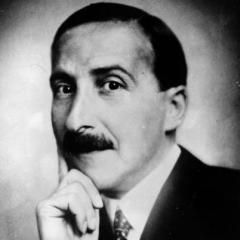
Stefan Zweig
Stefan Zweig

Stefan Zweig, born on November 28, 1881 in Vienna, was an Austrian novelist, playwright, and biographer. Known for his profound psychological insights and unique narrative style, he is a significant figure in European literature at the beginning of the 20th century. more

You May Also Like

“The greater part of our best years has been passed for our generation in these two great worldconvulsions. All will be changed after this war, which spends in one month more than nations earned before in yearsthere is no more security in our time than in those of the Reformation or the fall of Rome.”

“I am not fooling myself with dreams of immortality, know how relative all literature is, don't have any faith in mankind, derive enjoyment from too few things. Sometimes these crises give birth to something worth while, sometimes they simply plunge one deeper into depression, but, of course, it is all part of the same thing.”

“(Brazil:) I've never beheld such a paradise. The people are enchanting and--a mercy on this earth of ours--this is the only placewhere there isn't any race question. Negroes and whites and Indians, three-quarters, oneeighth, the wonderful Mulatto and Creole women, Jews and Christians, all dwell together in a peace that passes describing. The Jewish immigrants are in seventh heaven; all of them have jobs and feel at home.”

“Hearing, seeing and understanding each other, humanity from one end of the earth to the other now lives simultaneously, omnipresent like a god thanks to its own creative ability. And, thanks to its victory over space and time, it would now be splendidly united for all time, if it were not confused again and again by that fatal delusion which causes humankind to keep on destroying this grandiose unity and to destroy itself with the same resources which gave it power over the elements.”

“(Heinrich von) Kleist would not be a Prussian if his first thought would not have been orderlinessand he would not be a German if he had not placed all his hopes of developing this inner orderliness into education. Education is the secret of life for him as for every German: studying, learning a lot from books, sitting in lectures, keeping notebooks, listening intently to professors.”

“As nature requires whirlwinds and cyclones to release its excessive force in a violent revolt against its own existence, so the spirit requires a demonic human being from time to time whose excessive strength rebels against the community of thought and the monotony of moralityonly by looking at those beyond its limits does humanity come to know its own utmost limits.”

“Human life is so strangely constituted that even perfected intellectual understanding combined with the richest experience is incapable of conquering innate weaknesses. Even if it thoroughly analyzes itself, psychology (and this is one of the dubious aspects of psychoanalysis) can, to be sure, recognize its flawed native characteristics, but it cannot eliminate them. Understanding (them) is not the same as overcoming (them) and, again and again, we see the wisest of human beings helpless in the fact of their small follies which everyone else observes with a smile.”