Quotessence
Home / Quotes / Quote by Louis O. Kelso

Quote by Louis O. Kelso

Work

Two-factor Theory: the Economics of Reality; how to Turn Eighty Million Workers Into Capitalists on Borrowed Money, and Other Proposals

This book explores an economic theory that focuses on the conversion of workers into capitalist entities using borrowed funds and other economic mechanisms. It delves into the economic implications and strategies for such a transformation. more

Author
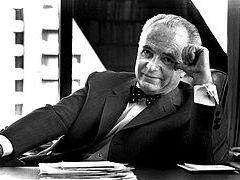
Louis O. Kelso
Louis O. Kelso

Louis O. Kelso was an American economist born on April 12, 1913. He is renowned for his extensive research in the fields of capital and distribution theories. Kelso proposed the concepts of 'shared economy' and 'profit sharing,' which have had a profound impact on subsequent economic theories and practices. more

You May Also Like

“Money is not a part of the visible sector of the economy; people do not consume money. Money is not a physical factor of production, but rather a yardstick for measuring economic input, economic outtake and the relative values of the real goods and services of the economic world. Money provides a method of measuring obligations, rights, powers and privileges. It provides a means whereby certain individuals can accumulate claims against others, or against the economy as a whole, or against many economies.”

“The owners of labor, on the other hand, are being taught, by the most powerful and well-publicized examples, that the highest rewards are not for production, but for the employment of organized power to take over a share of what others produce.”

“Thus, the capital owner is not a parasite or a rentier but a worker - a capital worker. A distinction between labor work and capital work suggests the lines along which we could develop economic institutions capable of dealing with increasingly capital-intensive production, as our present institutions cannot.”

“But would the young do any better under the same circumstances? Will they do any better when their turns come? The answer is that youth would not and cannot, given the financial and economic framework within which the elders are operating. While the moral convictions of individuals are important in the long run, it is institutions that determine the immediate course of events - particularly the institutions of finance.”

“It is preferable to regard labour, including, of course, the personal services of the entrepreneur, and his assistants, as the sole factor of production, operating in a given environment of technique, natural resources, capital equipment and effective demand. This is why we have been able to take labour as the sole physical unit which we require in our economic system, apart from units of money and of time.”

“I see, therefore, the rentier aspect of capitalism as a transitional phase which will disappear when it has done its work. And with the disappearance of its rentier aspect much else in it besides will suffer a sea-change. It will be, moreover, a great advantage of the order of events which I am advocating, that the euthanasia of the rentier, of the functionless investor, will be nothing sudden, merely a gradual but prolonged continuance of what we have seen recently in Great Britain, and will need no revolution.”

“It is not the ownership of the instruments of production which it is important for the State to assume. If the State is able to determine the aggregate amount of resources devoted to augmenting the instruments and the basic rate of reward to those who own them, it will have accomplished all that is necessary. Moreover, the necessary measures of socialization can be introduced gradually and without a break in the general traditions of society.”