Quotessence
Home / Quotes / Quote by Francis Galton

Quote by Francis Galton

Work

Inquiries into Human Faculty and Its Development

This work delves into the nature of the human mind and the factors that influence its growth and evolution. more

Author
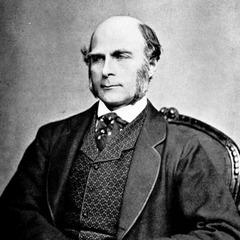
Francis Galton
Francis Galton

Francis Galton was a British polymath known for his work in statistics, anthropology, eugenics, and psychology. He was the half-cousin of Charles Darwin and is often credited with coining the term 'eugenics'. Galton's contributions to the field of statistics include the development of regression analysis and the application of correlation. He also conducted extensive research on heredity and intelligence, which influenced later theories in these areas. more

You May Also Like

“If [President Obama] does not go on the offensive against ISIS...they are coming here. This is just not about Baghdad, this is just not about Syria, this is about our homeland. And if we get attacked because he has no strategy to protect us, then he will have committed a blunder for the ages.”

“The best way of thinking of an attachment in my view, is to see it as the outcome of an interaction between two people, each of whom contributes to the quality of the relationship. Most parents can promote a secure relationship with a calm, pleasant, patient baby. Only particularly sensitive and patient parents can promote a secure attachment to a difficult baby.”

“Current conflicts and guilt about being a woman who is a mother and a person in her own right are a socially defined malaise, notan individual problem.... The conflict is not between being a mother and having a career; it is between nineteenth-century ideas about children and today's ideas about women.”

“Ideas about mothers have swung historically with the roles of women. When women were needed to work the fields or shops, experts claimed that children didn't need them much. Mothers, who might be too soft and sentimental, could even be bad for children's character development. But when men left home during the Industrial Revolution to work elsewhere, women were "needed" at home. The cult of domesticity and motherhood became a virtue that kept women in their place.”

“Parents who are cowed by temper tantrums and screaming defiance are only inviting more of the same. Young children become more cooperative with parents who confidently assert the reasons for their demands and enforce reasonable rules. Even if there are a few rough spots, relationships between parents and young children run more smoothly when the parent, rather than the child, is in control.”

“All in all, the communally reared children of Israel are far from the emotional disasters that psychoanalytic theory predicted. Neither have they been saved from all personality problems, as the founders of the kibbutz movement had hoped when they freed children from their parents. In any reasonable environment, children seem to grow up to be themselves. There is no evidence that communal rearing with stimulating, caring adults is either the ruination or the salvation of children.”

“It is important for practical and psychological reasons to call any reasonably stable group that rears children a family.... The advantage of this view is that traditional and nontraditional families can all be seen to serve the interests of children. Children can also feel comfortable with an approved family form, even if it is not traditional.”