Quotessence
Home / Quotes / Quote by Pope Leo XIII

Quote by Pope Leo XIII

“Whoso turns his attention to the bitter strifes of these days and seeks a reason for the troubles that vex public and private life must come to the conclusion that a fruitful cause of the evils which now afflict, as well as of those which threaten us, lies in this: that false conclusions concerning divine and human things, which originated in the schools of philosophy, have crept into all the orders of the state, and have been accepted by the common consent of the masses.”

Quote by Pope Leo XIII

Author
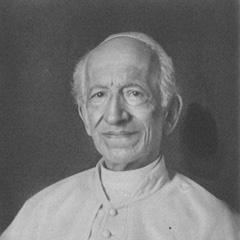
Pope Leo XIII
Pope Leo XIII

Pope Leo XIII (born Vincenzo Gioacchino Raffaele Luigi Pecci) served as the 256th Pope of the Catholic Church from 1878 to 1903, making him one of the longest-reigning popes in history. Born on March 2, 1810, in Carpineto, Italy, he died on July 20, 1903, in Rome. He is renowned for establishing modern Catholic social teaching through his landmark encyclical Rerum Novarum (1891), which addressed workers' rights and became a foundation of Catholic social doctrine. Leo XIII promoted Thomistic philosophy and worked to reconcile the Catholic Church with the modern world. more

You May Also Like

“It has been the fashion to speak of the conflict between human rights and property rights, and from this it has come to be widely believed that the use of private property is tainted with evil and should not be espoused by rational and civilized men... the only dependable foundation of personal liberty is the personal economic security of private property. The Good Society.”

“There are but three political-economic roads from which we can choose... We could take the first course and further exacerbate the already concentrated ownership of productive capital in the American economy. Or we could join the rest of the world by taking the second path, that of nationalization. Or we can take the third road, establishing policies to diffuse capital ownership broadly, so that many individuals, particularly workers, can participate as owners of industrial capital. The choice is ours.”

“Bring on those tired, labor-plagued, competition-weary companies and ESOP will breathe new life into them. They will find ESOP better than Geritol. It will revitalize what is wrong with capitalism. It will increase productivity. It will improve labor relations. It will promote economic justice. It will save the economic system. It will make our form of government and our concept of freedom prevail over those who don't agree with us.”

“Two things, Christian reader, particularly excite the will of man to good. A principle of justice is one, the other the profit we may derive therefrom. All wise men, therefore, agree that justice and profit are the two most powerful inducements to move our wills to any undertaking. Now, though men seek profit more frequently than justice, yet justice is in itself more powerful.”

“We must bear in mind, then, that there is nothing more difficult and dangerous, or more doubtful of success, than an attempt to introduce a new order of things in any state. For the innovator has for enemies all those who derived advantages from the old order of things, whilst those who expect to be benefited by the new institutions will be but lukewarm defenders.”

“We are free today substantially, but the day will come when our Republic will be an impossibility. It will be an impossibility because wealth will be concentrated in the hands of a few. A Republic cannot stand upon bayonets, and when the day comes when the wealth of the nation will be in the hands of a few, then we must rely upon the wisdom of the best elements in the country to readjust the laws of the nations to the changed conditions.”

“In Harlem, for instance, all of the stores are owned by white people, all of the buildings are owned by white people. The black people are just there - paying rent, buying the groceries; but they don't own the stores, clothing stores, food stores, any kind of stores; don't even own the homes that they live in. They are all owned by outsiders, and for these run-down apartment dwellings, the black man in Harlem pays more money than the man down in the rich Park Avenue section.”