Quotessence
Home / Quotes / Quote by Roland Barthes

Quote by Roland Barthes

“The signifier of myth presents itself in an ambiguous way: it is at the same time meaning and form, full on one side and empty on the other. […] The meaning will be for the form like an instantaneous reserve of history, a tamed richness, which it is possible to call and dismiss in a sort of rapid alternation: the form must constantly be able to be rooted again in the meaning and to get there what nature it needs for its nutriment; above all, it must be able to hide there. It is this constant game of hide-and-seek between the meaning and the form which defines myth.”

Quote by Roland Barthes

Work

Mythologies

An in-depth exploration of how myths from various cultures have shaped contemporary society, literature, and the human psyche. more

Author

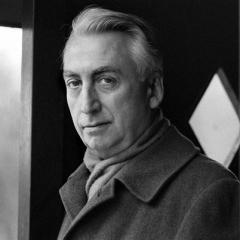
Roland Barthes
Roland Barthes

Roland Barthes (November 12, 1915 – March 25, 1980) was a French philosopher, literary critic, semiotician, and sociologist. He was a leading figure in structuralism and post-structuralism, known for his profound insights into semiotics, cultural criticism, and literary theory. His works, such as Mythologies, S/Z, and The Death of the Author, challenged traditional notions of authorship and meaning, emphasizing the multiplicity of texts and the active role of readers. Barthes' interdisciplinary approach influenced cultural studies, media analysis, and postmodern thought, making him one of the most influential intellectuals of the 20th century. more

You May Also Like

“It would be tedious to relate the Gradgrindian detail - economic, social and cultural (in the anthropological sense) - with which Scottish Screen implemented its industrial model during the thirteen years of its existence between 1997 and 2010. Collectively, the Scottish Screen website's policy guidelines and application forms for its innumerable schemes at every level of production and training constituted a manual for how to crush the life out of a creative project.”

“If I have so far argued that Foucault is a kind of closet liberal and thus deeply modern, I need to be equally critical of evangelical (and especially American) Christianity's modernity and its appropriation of Enlightenment notions of the autonomous self. Indeed, many otherwise orthodox Christians, who recoil at the notion of theological liberalism, have unwittingly adopted notions of freedom and autonomy that are liberal to the core. Averse to hierarchies and control, contemporary evangelicalism thrives on autonomy: the autonomy of the nondenominational church, at a macrocosmic level, and the autonomy of the individual Christian, at the microcosmic level. And it does not seem to me that the emerging church has changed much on this score; indeed, some elements of emergent spirituality are intensifications of this affirmation of autonomy and a laissez-faire attitude with respect to institutions.”

“This notion that we must wait and wait while we slowly progress out of enslavement into liberation, out of ignorance into knowledge, out of the present limitations into a future union with the Divine, is only true if we let it be so. But we need not. We can shift our identification from the ego to the Overself in our habitual thinking, in our daily reactions and attitudes, in our response to events and the world. We have thought our way into this unsatisfactory state; we can unthink our way out of it. By incessantly remembering what we really are, here and now at this very moment, we set ourselves free. Why wait for what already is?”

“This then is the ultimate truth--that in our inmost nature we are anchored in God, inseparable from God, and that the discovery of this heavenly nature is life's loftiest purpose. Even now, already, today, we are as divine as we ever shall be. The long evolutionary ladder which by prophets and teachers, gurus and guides we are bidden to climb toilsomely and slowly and painfully need not be climbed at all if only we heed this truth continually, if we refuse to let it go, if we make it ours in all parts of our being--in thought, feeling, faith, and action.”