Quotessence
Home / Quotes / Quote by Mary Wollstonecraft Shelley

Quote by Mary Wollstonecraft Shelley

“The day of my departure at length arrived. Clerval spent the last evening with us. He had endeavoured to persuade his father to permit him to accompany me and to become my fellow student, but in vain. His father was a narrow-minded trader, and saw idleness and ruin in the aspirations and ambition of his son. Henry deeply felt the misfortune of being debarred from a liberal education. He said little, but when he spoke I read in his kindling eye and in his animated glance a restrained but firm resolve not to be chained to the miserable details of commerce.”

Quote by Mary Wollstonecraft Shelley

Work

Frankenstein

Written by Mary Shelley, Frankenstein tells the story of a young scientist who creates a creature in the likeness of a human but is ultimately rejected by society. The novel delves into the consequences of scientific ambition and the moral implications of life creation. more

Author

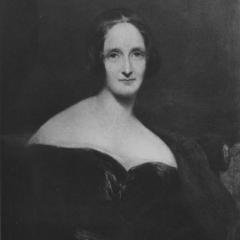
Mary Wollstonecraft Shelley

Mary Wollstonecraft Shelley was an English novelist best known for her famous work, 'Frankenstein'. Born on August 30, 1797, and passing away on February 1, 1851, she was an early female writer whose works explored themes such as women's rights, social inequalities, and scientific ethics. more

You May Also Like

“[T]aking the Third into account does not bring us into the position of pragmatic consideration, of comparing different Others; the task is rather to learn to distinguish between false conflicts and the true conflict. For example, today's conflict between Western liberalism and religious fundamentalism is a false one, since it is based on the exclusion of the third term which is its truth: the Leftist emancipatory position.”

“When I entered college, it was to study liberal arts. At the University of Pennsylvania, I studied English literature, but I fell in love with broadcasting, with telling stories about other people's exploits.”

“There were reprints of American editorials. Liberals saw it as a resurgence of social protest and decried the discrimination, poverty, and hunger that had provoked it. Conservative columnists acidly pointed out that hungry people don't steal stereo systems first and called for a crackdown in law enforcement. All of the reasoned editorials sounded hollow in light of the perverse randomness of the event. It was as if only a thin wall of electric lighting protected the great cities of the world from total barbarism.”