Quotessence
Home / Quotes / Quote by Rutherford B. Hayes

Quote by Rutherford B. Hayes

“Personally I do not resort to force - not even the force of law - to advance moral reforms. I prefer education, argument, persuasion, and above all the influence of example - of fashion.”

Quote by Rutherford B. Hayes

Author
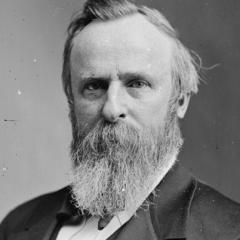
Rutherford B. Hayes
Rutherford B. Hayes

Rutherford B. Hayes was the 19th President of the United States, born on October 4, 1822, and died on January 17, 1893. During his presidency, he focused on maintaining national unity and restoring the economy, implementing a series of reform measures. more

You May Also Like

“Those who keep the masses of men in subjection by exercising force and cruelty deprive them at once of two vital foods, liberty and obedience; for it is no longer within the power of such masses to accord their inner consent to the authority to which they are subjected. Those who encourage a state of things in which the hope of gain is the principle motive take away from men their obedience, for consent which is its essence is not something which can be sold.”

“Why does everyone take for granted that we don't learn to grow arms, but rather, are designed to grow arms? Similarly, we should conclude that in the case of the development of moral systems; there's a biological endowment which in effect requires us to develop a system of moral judgment and a theory of justice, if you like, that in fact has detailed applicability over an enormous range.”

“Of all the differences between man and the lower animals, the moral sense or conscience is by far the most important. This sense, as Mackintosh remarks, "has a rightful supremacy over every other principle of human action"; it is summed up in that short but imperious word "ought," so full of high significance. It is the most noble of all the attributes of man, leading him without a moment's hesitation to risk his life for that of a fellow-creature; or after due deliberation, impelled simply by the deep feeling of right or duty, to sacrifice it in some great cause.”

“Ultimately a highly complex sentiment, having its first origin in the social instincts, largely guided by the approbation of our fellow-men, ruled by reason, self-interest, and in later times by deep religious feelings, confirmed by instruction and habit, all combined, constitute our moral sense or conscience.”

“To have something to say is a question of sleepless nights and worry and endless ratiocination of subject - of endless trying to dig out the essential truth, the essential justice. As a first premise you have to develop a conscience and if on top of that you have talent so much the better. But if you have talent without the conscience, you are just one of many thousands of journalists.”

“In regard to the past, where contemplation is not obscured by desire and the need for action, we see, more clearly than in the lives about us, the value for good and evil, of the aims men have pursued and the means they have adopted. It is good, from time to time, to view the present as already past, and to examine what elements it contains that will add to the world's store of permanent possessions, that will live and give life when we and all our generation have perished.”