Quotessence
Home / Quotes / Quote by Aldous Huxley

Quote by Aldous Huxley

“Whatever one says on the air is bound to be misunderstood; for people take from the heard or printed discourse that which they are predisposed to hear or read, not what is there- all that TV can do is to increase the number of misunderstanders by many thousandfold – and at the same time to increase the range of misunderstanding by providing no objective text to which the voluntarily ignorant can be made to refer.”

Quote by Aldous Huxley

Work

Moksha: Writings on Psychedelics and the Visionary Experience

Browse quotes and source details for this work. more

Author
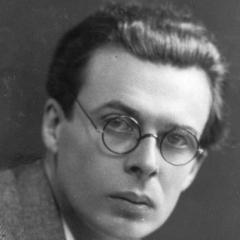
Aldous Huxley
Aldous Huxley

Aldous Huxley was an English writer and philosopher, renowned for his dystopian novel 'Brave New World'. Born on July 26, 1894, in Godalming, Surrey, England, he was the younger brother of the poet and critic Leonard Huxley. Huxley's works frequently delved into the interplay of science, politics, and philosophy, and he was a prominent figure in the literary movement known as the 'Lost Generation'. He passed away on November 22, 1963. more

You May Also Like

“I am beginning to be sorry that I ever undertook to write this book. Not that it bores me; I have nothing else to do; indeed, it is a welcome distraction from eternity. But the book is tedious, it smells of the tomb, it has a rigor mortis about it; a serious fault, and yet a relatively small one, for the great defect of this book is you, reader. You want to live fast, to get to the end, and the book ambles along slowly; you like straight, solid narrative and a smooth style, but this book and my style are like a pair of drunks; they stagger to the right and to the left, they start and they stop, they mutter, they roar, they guffaw, they threaten the sky, they slip and fall... And fall! Unhappy leaves of my cypress tree, you had to fall, like everything else that is lovely and beautiful; if I had eyes, I would shed a tear of remembrance for you. And this is the great advantage in being dead, that if you have no mouth with which to laugh, neither have you eyes with which to cry.”

“The global jihad espoused by Osama bin Laden and other contemporary extremists is clearly rooted in contemporary issues and interpretations of Islam. It owes little to the Wahhabi tradition, outside of the nineteenth-century incorporation of the teachings of Ibn Taymiyya and the Ibn al-Qayyim al-Jawziyyah into the Wahhabi worldview as Wahhabism moved beyond the confines of Najd and into the broader Muslim world. The differences between the worldviews of bin Laden and Ibn Abd al-Wahhab are numerous. Bin Laden preaches jihad; Ibn Abd al-Wahhab preached monotheism. Bin Laden preaches a global jihad of cosmic importance that recognizes no compromise; Ibn Abd al-Wahhab’s jihad was narrow in geographic focus, of localized importance, and had engagement in a treaty relationship between the fighting parties as a goal. Bin Laden preaches war against Christians and Jews; Ibn Abd al-Wahhab called for treaty relationships with them. Bin Laden’s jihad proclaims an ideology of the necessity of war in the face of unbelief; Ibn Abd al-Wahhab preached the benefits of peaceful coexistence, social order, and business relationships. Bin Laden calls for the killing of all infidels and the destruction of their money and property; Ibn Abd al-Wahhab restricted killing and the destruction of property… The militant Islam of Osama bin Laden does not have its origins in the teachings of Ibn Abd al-Wahhab and is not representative of Wahhabi Islam as it is practiced in contemporary Saudi Arabia, yet for the media it has come to define Wahabbi Islam in the contemporary era. However, “unrepresentative” bin Laden’s global jihad of Islam in general and Wahhabi Islam in particular, its prominence in headline news has taken Wahhabi Islam across the spectrum from revival and reform to global jihad.”

“In contemporary parlance, the term Salafi has come to acquire many different connotations. It has been used to refer to some groups who consider it obligatory to take up arms against all those - non-Muslims and Muslims - who are deemed to challenge or contravene the dictates of the Islamic foundational texts, the Qur'an and the normative example of the Prophet Muhammad (the sunna). At the other end of spectrum, it refers to a politically quietist trend, typified by the Saudi religious establishment, that rejects all beliefs and practices seen as compromising the oneness of God (tawhid) while leaving politics largely to the rulling elite. But the term Salafi is also used for, and by, those who reject the authority of the medieval schools of law and insist on an unmediated access to the foundational texts as the source of all norms.”

“From the time of the birth of the madhabs around the second century until now, an overwhelming majority of the Umma (Muslim nation) has been following them. In fact, for hundreds of years, there was not a single Scholar worth the name except that he belonged to one of the madhabs including Al-Shaykh Ibn Taymiyya and his most famous student Ibn Al-Qayyim who were both followers of the Hanbali school.”

“Ibn al-Wahhab was not the godfather of contemporary terrorist movements. Rather, he was a voice of reform, reflecting mainstream eighteenth-century Islamic thought. His vision of Islamic society was based upon monotheism in which Muslims, Christians, and Jews were to enjoy peaceful co-existence and cooperative commercial treaty relations.”