Quotessence
Home / Quotes / Quote by Martin Luther King, Jr.

Quote by Martin Luther King, Jr.

Work

The Trumpet of Conscience

This book delves into the profound concepts of conscience, examining its significance in individual and collective moral decision-making. It explores the intersection of ethics, spirituality, and societal values, offering a critical examination of the human condition. more

Author
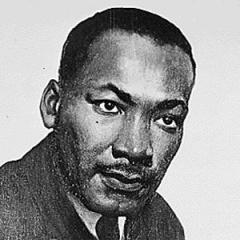
Martin Luther King, Jr.

Martin Luther King Jr. was an American civil rights activist known for his nonviolent protest and advocacy for equal rights. His 'I Have a Dream' speech at the Lincoln Memorial in 1963 became a significant milestone in the American civil rights movement. more

You May Also Like

“Nothing is very strong: strong enough to steal away a man's best years not in sweet sins but in a dreary flickering of the mind over it knows not what and knows not why, in the gratification of curiosities so feeble that the man is only half aware of them, in drumming of fingers and kicking of heels, in whistling tunes that he does not like, or in the long, dim labyrinth of reveries that have not even lust or ambition to give them a relish, but which, once chance association has started them, the creature is took weak and fuddled to shake off.”

“By this method thousands of humans have been brought to think that humility means pretty women trying to believe they are ugly and clever men trying to believe they are fools. And since what they are trying to believe may, in some cases, be manifest nonsense, they cannot succeed in believing it and we have the chance of keeping their minds endlessly revolving on themselves in an effort to achieve the the impossible.”

“The Enemy wants to bring the man to a state of mind in which he could design the best cathedral in the world, and know it to be the best, and rejoice in the fact, without being any more (or less) or otherwise glad at having done it than he would be if it had been done by another. The Enemy wants him, in the end, to be so free from any bias in his own favour that he can rejoice in his own talents as frankly and gratefully as in his neighbour's talents--or in a sunrise, an elephant, or a waterfall.”

“You must therefore zealously guard in his mind the curious assumption 'My time is my own'. Let him have the feeling that he starts each day as the lawful possessor of twenty-four hours. Let him feel as a grievous tax that portion of this property which he has to make over to him employers, and as a generous donation that further portion which h allows to religious duties. But what he must never be permitted to doubt is that the total from which these deductions have been made was, in some mysterious sense, his own personal birthright.”

“Whatever he says, let his inner resolution be not to bear whatever comes to him, but to bear it 'for a reasonable period'--and let the reasonable period be shorter than the trial is likely to last. It need not be much shorter; in attacks on patience, chastity, and fortitude, the fun is to make the man yield just when (had he but known it) relief was almost in sight.”