Quotessence
Home / Quotes / Quote by Michelle Alexander

Quote by Michelle Alexander

“Today it is perfectly legal to discriminate against criminals in nearly all the ways that it was once legal to discriminate against African Americans. Once you're labeled a felon, the old forms of discrimination - employment discrimination, housing discrimination, denial of the right to vote, denial of educational opportunity, denial of food stamps and other public benefits, and exclusion from jury service - are suddenly legal.”

Quote by Michelle Alexander

Author
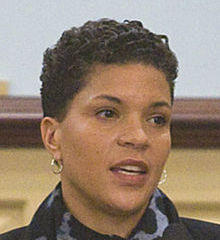
Michelle Alexander
Michelle Alexander

Michelle Alexander is a distinguished professor of law at the University of California, Berkeley. Born on October 7, 1967, she is recognized for her expertise in criminal justice and civil rights. Alexander has authored numerous articles and books on the subject of mass incarceration in the United States and its effects on African American communities. more

You May Also Like

“For African American children, in particular, the odds are extremely high that they will have a parent or loved one, a relative, who has either spent time behind bars or who has acquired a criminal record and thus is part of the under-caste - the group of people who can be legally discriminated against for the rest of their lives. For many African American children, their fathers, and increasingly their mothers, are behind bars. It is very difficult for them to visit. Many people are held hundreds or even thousands of miles away from home.”

“For children, the era of mass incarceration has meant a tremendous amount of family separation, broken homes, poverty, and a far, far greater level of hopelessness as they see so many of their loved ones cycling in and out of prison. Children who have incarcerated parents are far more likely themselves to be incarcerated.”

“When young black men reach a certain age - whether or not there is incarceration in their families - they themselves are the target of police stops, interrogations, frisks, often for no reason other than their race. And, of course, this level of harassment sends a message to them, often at an early age: No matter who you are or what you do, you're going to find yourself behind bars one way or the other. This reinforces the sense that prison is part of their destiny, rather than a choice one makes.”

“Certainly youth of color, particularly those in ghetto communities, find themselves born into the cage. They are born into a community in which the rules, laws, policies, structures of their lives virtually guarantee that they will remain trapped for life. It begins at a very early age when their parents themselves are either behind bars or locked in a permanent second-class status and cannot afford them the opportunities they otherwise could.”

“Middle-class white children, children of privilege, are afforded the opportunity to make a lot of mistakes and still go on to college, still dream big dreams. But for kids who are born in the ghetto in the era of mass incarceration, the system is designed in such a way that it traps them, often for life.”

“The wave of punitiveness that washed over the United States with the rise of the drug war and the get tough movement really flooded our schools. Schools, caught up in this maelstrom, began viewing children as criminals or suspects, rather than as young people with an enormous amount of potential struggling in their own ways and their own difficult context to make it and hopefully thrive. We began viewing the youth in schools as potential violators rather than as children needing our guidance.”

“The mythology around colorblindness leads people to imagine that if poor kids of color are failing or getting locked up in large numbers, it must be something wrong with them. It leads young kids of color to look around and say: "There must be something wrong with me, there must be something wrong with us. Is there something inherent, something different about me, about us as a people, that leads us to fail so often, that leads us to live in these miserable conditions, that leads us to go in and out of prison?"”