Quotessence
Home / Quotes / Quote by Joan Dye Gussow

Quote by Joan Dye Gussow

Author

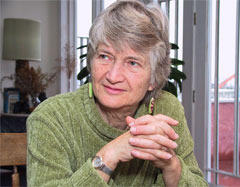
Joan Dye Gussow
Joan Dye Gussow

Joan Dye Gussow is a renowned professor, born in 1928. She is known for her contributions to the fields of nutrition and sustainable food systems. more

You May Also Like

“The most difficult task, phase-out over the next 20-25 years of coal use that does not capture CO₂, is Herculean, yet feasible when compared with the efforts that went into World War II. The stakes, for all life on the planet, surpass those of any previous crisis. The greatest danger is continued ignorance and denial, which could make tragic consequences unavoidable.”

“If humanity wishes to preserve a planet similar to that on which civilisation developed and to which life on Earth is adapted, paleoclimate evidence and ongoing climate change suggest that CO₂ will need to be reduced from its current 385 ppm [parts per million] to at most 350 ppm... If the present overshoot of this target CO₂ is not brief, there is a possibility of seeding irreversible catastrophic effects.”

“Our analysis shows that, for the extreme hot weather of the recent past, there is virtually no explanation other than climate change. The deadly European heat wave of 2003, the fiery Russian heat wave of 2010 and catastrophic droughts in Texas and Oklahoma last year [2011] can each be attributed to climate change. The odds that natural variability created these extremes are minuscule, vanishingly small. To count on those odds would be like quitting your job and playing the lottery every morning to pay the bills.”

“Because nitrous oxide [released by nitrate-fertilised soil] is 296 times stronger than CO₂ at global warming and methane [cow farts] is about 26 times as potent as CO₂, the combined greenhouse effect of our livestock worldwide is greater than the sum total of all the cars, trains, busses, trucks, ships, airplanes and jets.”

“When the Europeans first arrived in North America, the average depth of the topsoil was 53.34 cm (1¾ ft) and it was rich in the types of symbiotic organisms necessary for plant roots to absorb minerals from the soil. Today North America averages around 15.24 cm (6 in) of topsoil and most if it is exhausted of nutrients and much is devoid of life.”

“The industrial civilisation is based on the consumption of energy resources that are inherently limited in quantity and that are about to become scarce. When they do, competition for what remains will trigger dramatic economic and geopolitical events; in the end, it may be impossible for even a single nation to sustain industrialism as we have know it in the twentieth century.”

“Early ecologists soon realised that, since humans are organisms, ecology should include the study of the relationship between humans and the rest of the biosphere. ... We don't often tend to think about the social sciences (history, economics and politics) as subcategories of ecology. But since people are organisms, it is apparent that we must first understand the principles of ecology if we are to make sense of the events in the human world.”