Quotessence
Home / Quotes / Quote by Stephen Jay Gould

Quote by Stephen Jay Gould

“I have often been amused by our vulgar tendency to take complex issues, with solutions at neither extreme of a continuum of possibilities, and break them into dichotomies, assigning one group to one pole and the other to an opposite end, with no acknowledgment of subtleties and intermediate positions and nearly always with moral opprobrium attached to opponents.”

Quote by Stephen Jay Gould

Work

The Flamingo's Smile: Reflections in Natural History

This volume gathers a series of reflective essays that examine the quirks and complexities of the natural world. The title refers to the peculiar anatomy of flamingos, which feed with their heads upside down, creating an illusion of a smile. The essays delve into topics such as adaptation, evolutionary puzzles, and the intricate relationships between organisms and their environments. The author uses these observations to challenge conventional thinking and highlight the wonder of biological diversity, without relying on technical jargon, making the content accessible to a general audience interested in science and nature. more

Author
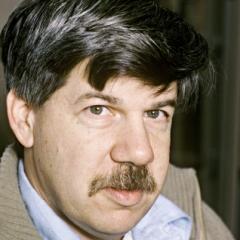
Stephen Jay Gould
Stephen Jay Gould

Stephen Jay Gould was a renowned paleontologist, evolutionary theorist, science writer, and academic. He is known for his work in ornithology, paleontology, evolutionary theory, and speciation. Gould's writings and papers have had a profound impact on the scientific community, and he was a long-time contributor to the journal 'Nature'. more

You May Also Like

“I like to summarize what I regard as the pedestal-smashing messages of Darwin's revolution in the following statement, which might be chanted several times a day, like a Hare Krishna mantra, to encourage penetration into the soul: Humans are not the end result of predictable evolutionary progress, but rather a fortuitous cosmic afterthought, a tiny little twig on the enormously arborescent bush of life, which, if replanted from seed, would almost surely not grow this twig again, or perhaps any twig with any property that we would care to call consciousness.”

“The intricate and different life cycles of both male and female root-heads, and the great behavioral sophistication shown by the female in reconfiguring a host crab as a support system, all underscore the myopia of our conventional wisdom in regarding rhizocephalans as degenerate parasites because the adult anatomy of internal roots and external sac seem so simple.”

“Knowledge and wonder are the dyad of our worthy lives as intellectual beings. Voyager did wonders for our knowledge, but performed just as mightily in the service of wonder and the two elements are complementary, not independent or opposed. The thought fills me with awe - a mechanical contraption that could fit in the back of a pickup truck, traveling through space for twelve years, dodging around four giant bodies and their associated moons, and finally sending exquisite photos across more than four light-hours of space from the farthest planet in our solar system.”

“Evolution is an obstacle course not a freeway; the correct analogue for long-term success is a distant punt receiver evading legions of would-be tacklers in an oddly zigzagged path toward a goal, not a horse thundering down the flat.”

“Since the universe must contain millions of appropriate planets, consciousness in some form - but not with the paired eyes and limbs, and the brain built of neurons in the only example we know - may evolve frequently. But if only one origin of life in a million ever leads to consciousness, then Martian bacteria most emphatically do not imply Little Green Men.”

“The theory of punctuated equilibrium, proposed by Niles Eldredge and myself, is not, as so often misunderstood, a radical claim for truly sudden change, but a recognition that ordinary processes of speciation, properly conceived as glacially slow by the standard of our own life-span, do not resolve into geological time as long sequences of insensibly graded intermediates (the traditional, or gradualistic, view), but as geologically "sudden" origins at single bedding planes.”