“I really see no harm which can come of giving our children a little knowledge of physiology. ... The instruction must be real, based upon observation, eked out by good explanatory diagrams and models, and conveyed by a teacher whose own knowledge has been acquired by a study of the facts; and not the mere catechismal parrot-work which too often usurps the place of elementary teaching.”
Quote by Thomas Huxley
Work
Science and Culture: And Other Essays
This volume compiles a series of essays that delve into the relationship between scientific advancements and cultural developments, offering insights into how scientific discoveries have influenced and been influenced by societal and cultural contexts. more
Author
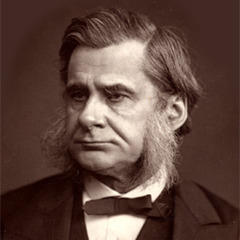
Thomas Huxley
Thomas Huxley, a British biologist, was a staunch supporter of Darwin's theory of evolution. Renowned for his research in comparative anatomy, embryology, paleontology, and philosophy, Huxley made significant contributions to the field of biology. He had a profound influence on science, not only through his support of Darwin's theory of evolution but also through his role as a science popularizer and advocate for science education. more
You May Also Like
Source: The Complete Poetical Works of William Wordsworth: Together with a Description of the Country of the Lakes in the North of England, Now First Published with His Works ...
Source: How to solve it: a new aspect of mathematical method
Source: William Jennings Bryan on Orthodoxy, Modernism, and Evolution
Source: Dave Barry Is Not Taking This Sitting Down
Source: How to solve it: a new aspect of mathematical method
Source: Elementary Mathematics from a Higher Standpoint: Volume I: Arithmetic, Algebra, Analysis