Quotessence
Home / Quotes / Quote by Salman Rushdie

Quote by Salman Rushdie

“The most important of these things is that art challenges orthodoxy. To reject or vilify art because it does that is to fail to understand its nature. Art sets the artist’s passionate personal vision against the received ideas of its time. Art knows that received ideas are the enemies of art, as Flaubert told us in Bouvard and Pécuchet. Clichés are received ideas and so are ideologies, both those which depend on the sanction of invisible sky gods and those which do not. Without art, our ability to think, to see freshly, and to renew our world would wither and die.Art is not a luxury. It stands at the essence of our humanity, and it asks for no special protection except the right to exist.It accepts argument, criticism, even rejection. It does not accept violence.And in the end, it outlasts those who oppress it. The poet Ovid was exiled by Augustus Caesar, but the poetry of Ovid has outlasted the Roman Empire. The poet Mandelstam’s life was ruined by Joseph Stalin, but his poetry has outlasted the Soviet Union. The poet Lorca was murdered by the thugs of General Franco, but his art has outlasted the fascism of the Falange.”

Quote by Salman Rushdie

Work

Knife: Meditations After an Attempted Murder

Browse quotes and source details for this work. more

Author
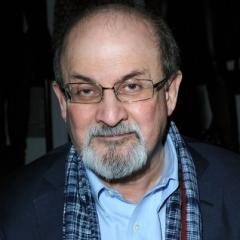
Salman Rushdie
Salman Rushdie

Salman Rushdie (born June 19, 1947) is a British-Indian novelist and essayist. Known for his magical realism style, his novel Midnight's Children won the Booker Prize in 1981. His works often explore themes of cultural conflict, religion, and politics. In 1988, his novel The Satanic Verses sparked global controversy, leading to a fatwa issued by Iran's Ayatollah Khomeini calling for his assassination. Rushdie spent years in hiding under police protection. He remains a prominent voice in contemporary English literature, celebrated for his literary innovation and defense of free expression. more

You May Also Like

“I feel that the cartoon should involve something happening that could not possibly happen, but which has a kind of truth to it. There should be a give-and-take between the truth and the implausibility. If those two things are going on at the exact same time, and they’re both equal in weight, then the brain has a conflict that it has to resolve, and it can only resolve it through laughter.”

“There is some confusion as to what magic actually is. I think this can be cleared up. If you just look at the very earliest descriptions of magic. Magic in its earliest form is often referred to as "the art". I believe that this is completely literal, I believe that magic is art and that art, whether that'd be writing, music, sculpture or any other form is literally magic. Art is, like magic, the science of manipulating symbols, words or images to achieve changes in consciousness. The very language of magic seems to be talking as much about writing or art as it is about supernatural events. A grimoire for example, the book of spells is simply a fancy way of saying grammar. Indeed, to cast a spell is simply to spell, to manipulate words, to change people's consciousness. And I believe this is why an artist or writer is the closest thing in the contemporary world that you are likely to see to a shaman. I believe all culture must have arisen from cult. Originally, all of the facets of our culture, whether they'd be in the arts or the sciences were the province of the shaman. The fact that in present times, this magical power has degenerated to the level of cheap entertainment and manipulation is I think a tragedy.”

“The works of the poets, sculptors, and representative artists in general contain an unacknowledged treasure of profound wisdom; just because out of them the wisdom of the nature of things itself speaks, whose utterances they merely interpret by illustrations and purer repetitions. On this account, however, every one who reads the poem or looks at the picture must certainly contribute out of his own means to bring that wisdom to light; accordingly he comprehends only so much of it as his capacity and culture admit of; as in the deep sea each sailor only lets down the lead as far as the length of the line will allow. Before a picture, as before a prince, every one must stand, waiting to see whether and what it will speak to him; and, as in the case of a prince, so here he must not himself address it, for then he would only hear himself.”

“They say women have no conscience about laws, don't they?" Mrs. MacAvelly suggested. "Why should we?" answered her friend. "We don't make 'em—nor God—nor nature. Why on earth should we respect a set of silly rules made by some men one day and changed by some more the next?" (from According to Solomon)”