Quotessence
Home / Quotes / Quote by Robert F. Kennedy, Jr.

Quote by Robert F. Kennedy, Jr.

Author
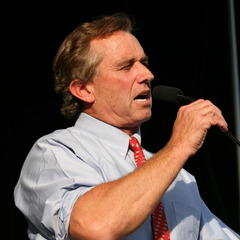
Robert F. Kennedy, Jr.

Robert F. Kennedy Jr., born January 17, 1954, is an American environmental lawyer, activist, and radio host. He is the son of former U.S. Attorney General Robert F. Kennedy and nephew of President John F. Kennedy. He founded Waterkeeper Alliance, a global environmental organization, and hosts a political commentary show on Sirius XM radio. He gained prominence through his environmental advocacy work and has become a controversial figure due to his political views. more

You May Also Like

“As citizen-activists the world over merge, they can become an irresistible force to create peace and protect the planet. From here will come a new movement to abolish nuclear weapons and all weapons of mass destruction. From here will come the demand for sustainable communities, for new systems of energy, transportation and commerce. From here comes the future rushing in on us. How does one acquire the capacity for active citizenship? The opportunities exist every day...Active citizenship begins with an envisioning of the desired outcome and a conscious application of spiritual principles.”

“Our oil-based society depends on non-renewable resources. It requires relentless probing into vast reaches of pristine land, sacrificing vital bioregions, and irreplaceable cultures. The possibility of catastrophic climate change is substantially increased by the 40 million barrels of oil burned every day by vehicles. We must all move shoulder to shoulder in a unified front to show this administration that the true majority of people are willing to vote for a cleaner environment and won't back down.”

“Business often does a good job supporting communities: the arts, universities, and scientific enterprises... But that philosophy has rarely reached poor countries. Even businesses that are enlightened in their home bases see Africa, Latin America, and parts of Asia as places to exploit natural resources or use cheap labor.”

“People would do well to ask themselves how many of their ambitions and aspirations derive from the type of economic system they inhabit and the insecurity and exhaustion it creates, and question the sense and purpose of a society where control of a large portion of life is abdicated under contract in the labour market, and where immense creativity and potential is stifled by the need to do difficult and repetitive tasks in order to earn a wage.”

“Whether there are innately female leadership styles... is not really the right question. It is more important to ask why there has been so little attention paid to women leaders over the years as well as why the styles of leading more often exhibited by women are particularly useful at this critical moment in history.”

“This leads to a question - if a great many people are for a certain project, is it necessarily right? If the vast majority is for it, is it even more certainly right? This, to be sure, is one of the tricky points of democracy. The minority often turns out to be right, and though one believes in the efficacy of the democratic process, one has also to recognize that the demand of the many for a particular project at a particular time may mean only disaster.”