Quotessence
Home / Quotes / Quote by Swami Vivekananda

Quote by Swami Vivekananda

“Whenever two particles come together, they are held by a certain attraction; and there will come a time when those particles will separate. This is the eternal law. So, wherever there is a body - either grosser or finer, either in heaven or on earth - death will overcome it.”

Quote by Swami Vivekananda

Work

The Complete Works of Swami Vivekananda

This book includes a wide range of Swami Vivekananda's teachings on spirituality, philosophy, and social issues, offering insights into his thoughts on various aspects of life and the human condition. more

Author
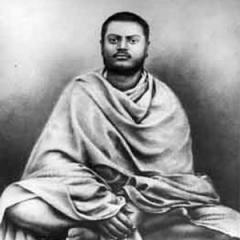
Swami Vivekananda
Swami Vivekananda

Swami Vivekananda (January 12, 1863 – July 4, 1902) was an Indian Hindu monk, philosopher, and social reformer. Born as Narendranath Datta in Kolkata, he was a chief disciple of the mystic Ramakrishna. He is best known for his historic speech at the 1893 Parliament of the World's Religions in Chicago, where he introduced Hinduism to the Western world. He founded the Ramakrishna Mission in 1897, focusing on social service, education, and interfaith harmony. His teachings emphasized self-realization, service to humanity, and the unity of all religions. He wrote extensively on yoga and Vedanta philosophy, influencing global spirituality and Indian nationalism. He died at the age of 39, leaving a lasting legacy as a bridge between Eastern and Western thought. more

You May Also Like

“The state of inequality between individuals and between nations not only still exists; it is increasing. It still happens that side by side with those who are wealthy and living in plenty there exist those who are living in want, suffering misery and often actually dying of hunger; and their number reaches tens, even hundreds of millions.”

“This is why moral uneasiness is destined to become even more acute. It is obvious that a fundamental defect, or rather a series of defects, indeed a defective machinery is at the root of contemporary economics and materialistic civilization, which does not allow the human family to break free from such radically unjust situations.”

“This kind of inequality - a level that we haven’t seen since the Great Depression - hurts us all. When middle-class families can no longer afford to buy the goods and services that businesses are selling...it drags down the entire economy from top to bottom. America was built on the idea of broad-based prosperity... That’s why a CEO like Henry Ford made it his mission to pay his workers enough so that they could buy the cars he made. It’s also why a recent study showed that countries with less inequality tend to have stronger and steadier economic growth over the long run.”

“Inequality also distorts our democracy. It gives an outsized voice to the few who can afford high-priced lobbyists and unlimited campaign contributions, and runs the risk of selling out our democracy to the highest bidder. And it leaves everyone else rightly suspicious that the system in Washington is rigged against them - that our elected representatives aren't looking out for the interests of most Americans.”

“This kind of gaping inequality gives lie to the promise that’s at the very heart of America: that this is a place where you can make it if you try. We tell people - we tell our kids - that in this country, even if you’re born with nothing, work hard and you can get into the middle class. We tell them that your children will have a chance to do even better than you do. That’s why immigrants from around the world historically have flocked to our shores.”