Quotessence
Home / Quotes / Quote by Bertrand Russell

Quote by Bertrand Russell

“Pure mathematics consists entirely of assertions to the effect that, if such and such a proposition is true of anything, then such and such another proposition is true of that thing. It is essential not to discuss whether the first proposition is really true, and not to mention what the anything is, of which it is supposed to be true. [...] Thus mathematics may be defined as the subject in which we never know what we are talking about, nor whether what we are saying is true. People who have been puzzled by the beginnings of mathematics will, I hope, find comfort in this definition, and will probably agree that it is accurate.”

Quote by Bertrand Russell

Work

Mysticism and Logic

This book delves into the conceptual relationship between mystical experiences and the principles of logical thought, examining how these two realms may be interconnected. more

Author

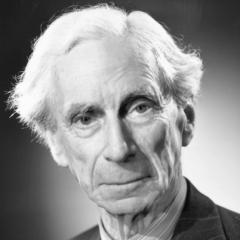
Bertrand Russell
Bertrand Russell

Bertrand Russell was a British philosopher, mathematician, and logician born on May 18, 1872, and died on February 2, 1970. He is known for his contributions to logic and mathematics, particularly in the fields of mathematical logic and philosophical analysis. His works spanned a wide range of subjects, including ethics, political philosophy, history, and literary criticism. more

You May Also Like

“The television commercial has mounted the most serious assault on capitalist ideology since the publication of Das Kapital. To understand why, we must remind ourselves that capitalism, like science and liberal democracy, was an outgrowth of the Enlightenment. Its principal theorists, even its most prosperous practitioners, believed capitalism to be based on the idea that both buyer and seller are sufficiently mature, well informed and reasonable to engage in transactions of mutual self-interest. If greed was taken to be the fuel of the capitalist engine, the surely rationality was the driver. The theory states, in part, that competition in the marketplace requires that the buyer not only knows what is good for him but also what is good. If the seller produces nothing of value, as determined by a rational marketplace, then he loses out. It is the assumption of rationality among buyers that spurs competitors to become winners, and winners to keep on winning. Where it is assumed that a buyer is unable to make rational decisions, laws are passed to invalidate transactions, as, for example, those which prohibit children from making contracts...Of course, the practice of capitalism has its contradictions...But television commercials make hash of it...By substituting images for claims, the pictorial commercial made emotional appeal, not tests of truth, the basis of consumer decisions. The distance between rationality and advertising is now so wide that it is difficult to remember that there once existed a connection between them. Today, on television commercials, propositions are as scarce as unattractive people. The truth or falsity of an advertiser's claim is simply not an issue. A McDonald's commercial, for example, is not a series of testable, logically ordered assertions. It is a drama--a mythology, if you will--of handsome people selling, buying and eating hamburgers, and being driven to near ecstasy by their good fortune. No claim are made, except those the viewer projects onto or infers from the drama. One can like or dislike a television commercial, of course. But one cannot refute it.”

“It's completely logical," explained the Dodecahedron. "The more you want, the less you get, and the less you get, the more you have. Simple arithmetic, that's all. Suppose you had something and added something to it. What would that make?" "More," said Milo quickly. "Quite correct," he nodded. "Now suppose you had something and added nothing to it. What would you have?" "The same," he answered again, without much conviction. "Splendid," cried the Dodecahedron. "And suppose you had something and added less than nothing to it. What would you have then?" "FAMINE!" roared the anguished Humbug, who suddenly realized that that was exactly what he'd eaten twenty-three bowls of.”

“The man who cannot believe his senses, and the man who cannot believe anything else, are both insane, but their insanity is proved not by any error in their argument, but by the manifest mistake of their whole lives. They have both locked themselves up in two boxes, painted inside with the sun and stars; they are both unable to get out, the one into the health and happiness of heaven, the other even into the health and happiness of the earth.”